Watering the Lawn

When I went outside to give my kid a ride on the swing, I discovered the mystery of the lawn irrigation. When they started the irrigation around my place it was going off multiple times a night, every night. I set out a tuna can, and found out they were applying a little over a half inch of water. Recently the irrigation was shut off entirely. The lawn is now quite dry and no longer lush green. So a neighbor came up to me and said that I must be cringing over the lawn. (I wasn’t. Just confused.) Turns out they had a leak in the system that needed to be fixed. She then said that they had an owner come up and say that this place looked like a dump due to dry grass. (Now I’m cringing.)

Where I am at, a lawn will survive with one irrigation a month. Not day, or even week. Month. This irrigation, and all irrigations for that matter, should be at least a half inch of water. One is better. If you do water that infrequently, the lawn will go dormant. Yellow, crispy, dormant. This is not a bad thing, and certainly doesn’t make a place a dump. Once it cools off, the lawn springs back into the lush greenness we love.

But most people like lush green lawn. That’s okay. You can get it by irrigating. But watering every day makes me cringe a lot, especially at a half-inch of water per irrigation. Its tons more water than the plant needs. Water the lawn ever day is a common practice around here, although why in the world it’s caught on is beyond me. More does tend to make lawn greener, although in a short-term non healthy way. It’s a lot like caffeine. Quick fix–but in the long run, the plants will crash. Plants, including the non-aquatic lawn, need a good night’s sleep rather than quick fixes. They need deep watering, much less frequently than is common.

I set one of my client’s clocks. Their lawn is watered twice a week, pretty deeply. (They also had a free water check, which is a great program if you are in Utah. They tell you how much to water based on the output of your system. So I really didn’t have to figure out how long to water to put a half inch on, I just set the clock.)  I’ll step it back when I stop by next time. Their lawn looks amazing. It’s getting less than a third of the water than the lawn at my complex was, and it’s actually more lush and healthy.

Do we have to maintain unnaturally lush green lawns in the heat of the summer? We can conserve a lot of water by allowing summer dormancy. But even if you want a green lawn, it needs a lot less water than you think. Please don’t follow what a neighbor is doing. Stop drowning the lawn.

Landscape Contractors

Recently, a weedy duplex near where I live received attention from a local landscape company. Within a few days, they had removed the weeds, put in some sod, various other shrubs and plants, and plenty of bark and rock mulch. This was all in mid-July, the hottest time of the year, but with proper irrigation it has all flourished and nothing is dead.

It’s nothing tremendously special, but a thousand times better than the weeds before. I wish they would have at least buried the rocks a bit so they look more natural, but no real complaints. The narrow park strip in this property was also dealt with well. I hate grass in park strips. Perennials are a good option if you have the room. But if the strip is narrow, I like this:

Rock mulch. No irrigation to water the cement, and no plants to get tramples and die. Narrow park strips just aren’t that functional. The only other option I would consider is low ground covers that can take a bit of traffic with a drip system. But the rocks are a lot easier.

Landscape contractors aren’t the cheapest way to create a garden, but they are fast and easy. Landscapers (good companies) also know what they are doing and avoid a lot of mistakes. They uses good plants, put in a decent irrigation system, and (hopefully) plant everything properly so it doesn’t die right off. The professionaly landscaped yards tend to have the same look about them around here. Curves, shrub beds with bark mulch and only a few different types of plants, and lawn. It’s better than what I normally see: lots and lots of lawn with teeny tiny planting beds.

Someday I will inspire someone to have only a bit of lawn and lots of neat plants. And it doesn’t have to include curves. (Not that there is anything wrong with curves. Just landscaped curves are so predicable and boring.) Or even better: I can do it myself. I will celebrate the day I get a house with a yard: and I won’t go out and hire a landscape contractor.

Harvest

This is one of the best times of the year. The heat has started to abate, but most of all it’s time to harvest. My harvest is smaller than in previous years (I had less space), but I’m quite pleased with it. I picked my first couple tomatoes yesterday, and ate one like an apple. Certainly not the best tomato I’ve ever had but still delicious. I’ve made ratatouille twice this week, with eggplant and pepper from my own garden and zucchini from others. (No need to grow that myself. I keep turning down requests to take even more than what I have.)

Ratatouille is my favorite dish from the garden harvest. I craved it in the spring and resorted to buying rubbery grocery store eggplant. Ick…should have waited until harvest. Now is when I can make as much as I want (almost) and eat to my heart’s content. My garden has most of the fixings: eggplant, tomatoes, peppers, herbs. All I need to add is zucchini, onion, garlic. I was just about to write what I did tonight in recipe form, but I can’t quite translate it. You will get a paragraph instead. I cut corners when I cook and try to do everything as easy as possible, so feel free to elaborate the idea.

I put butter in the bottom of a crock pot, and layered slices of tomatoes, eggplant, peppers and zucchini.  I sprinkled that all with garlic salt, Italian seasoning, and dried chopped onion. (Told you I cut corners. You could use real onion, etc.) I have no idea how much of each, just put on what looks good. Bake on high for 2-3 hours. I let it cool down, and used it to top toasted bagels, but have eaten it by itself, and on top of pasta.

Enjoy your harvests!

Curb-Side Makeover

On of my relative’s house is a very plain manufactured home:

I gave them a landscape design for a present and recently finished the front planting bed. I wanted to get rid of the look of the manufactured home, and add lots more plants. I went with plants that mirrored the blue-grey and maroon in the house color, focusing primarily on foliage color. There are actually lots of interesting blue-grey/purple-leafed plants out there, so it was a fun design to do. The following plan could be planted more heavily, but I decided it was  good enough start.

I also decided to experiment with a digital makeover. I saw some on another garden blog and wanted to give it a go. It wasn’t as hard as I thought it might be, and the results are dramatic. I think people are much more likly to follow a landscape plan when they can see it as it would turn out. Overhead plans are functional, but don’t have the wow factor. Here’s the generated image of the matured landscape:

I’m pleased with how it turned out and have shared it a lot. It is the first of a lot more mock-ups follow: I enjoy doing it and it helped my planting plan as well.

Harvest

This is one of the best times of the year. The heat has started to abate, but most of all it’s time to harvest. My harvest is smaller than in previous years (I had less space), but I’m quite pleased with it. I picked my first couple tomatoes yesterday, and ate one like an apple. Certainly not the best tomato I’ve ever had but still delicious. I’ve made ratatouille twice this week, with eggplant and pepper from my own garden and zucchini from others. (No need to grow that myself. I keep turning down requests to take even more than what I have.)

Ratatouille is my favorite dish from the garden harvest. I craved it in the spring and resorted to buying rubbery grocery store eggplant. Ick…should have waited until harvest. Now is when I can make as much as I want (almost) and eat to my heart’s content. My garden has most of the fixings: eggplant, tomatoes, peppers, herbs. All I need to add is zucchini, onion, garlic. I was just about to write what I did tonight in recipe form, but I can’t quite translate it. You will get a paragraph instead. I cut corners when I cook and try to do everything as easy as possible, so feel free to elaborate the idea.

I put butter in the bottom of a crock pot, and layered slices of tomatoes, eggplant, peppers and zucchini.  I sprinkled that all with garlic salt, Italian seasoning, and dried chopped onion. (Told you I cut corners. You could use real onion, etc.) I have no idea how much of each, just put on what looks good. Bake on high for 2-3 hours. I let it cool down, and used it to top toasted bagels, but have eaten it by itself, and on top of pasta.

Enjoy your harvests!

‘You Grow Girl’ Book Review

http://rcm.amazon.com/e/cm?lt1=_blank&bc1=000000&IS2=1&bg1=FFFFFF&fc1=216011&lc1=391F5A&t=ginkggarde-20&o=1&p=8&l=as1&m=amazon&f=ifr&asins=0743270142

I picked this book up at the library while I was browsing the gardening section. I had come upon Gayla Trail’s website before but didn’t really find much to interest me. I wondered if the book would be worth a read. I checked it out anyway, and ended up nearly reading it cover to cover.

It’s not a book I want to own, but it did make me think about how I garden. I was right in the intended audience: young, female, with a small space to garden in and a desire to grow food. The book focused on various crafts and creative ideas more than actual gardening knowledge, which is probably why I read it. I have garden knowledge, but I’m not especially crafty. I began to think of cool ideas I could incorporate into my own small garden, and now have a strong desire to make a gardening apron (in groovy colors of course).

It’s also not a bad beginning gardening book either. I skipped over a lot of the more simple stuff, and it is definitely opinion based (rather than objective, scientific). Not a bad read if you want some creative ideas for your small garden. And the book is quite pretty.

Stewart Falls

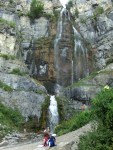
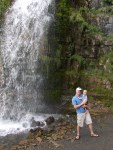
I’m surprised I had never heard of this hike or been on it before. It was a moderate/easy 2 mile hike to a gorgeous waterfall up by Sundance. Joe and I went there this past weekend. I am not in good hiking shape, but this trail didn’t kill me. I did feel like Peter and wanted to fall asleep at the end of it.

Previous to the hike, we had a picnic at Bridal Veil Falls. Joe had never stopped there before. I’ve climbed up the cascade before (and lost a shoe doing it) but climbing up with Peter wasn’t going to happen.

Patio Garden

I overhauled the patio garden. One day I looked at the stupid paving and decided it had to go. It was surprisingly easy to rip it out. I replaced small pavers with rocks in between (messy looking and my little kid loves to try and eat the rocks) with larger pavers and nothing in between.  There was a little extra room that the pavers didn’t fill up and I’m going to plant starts of my mom’s miniature thyme there.

The small pavers left over fit under my potted plants that were previously just on the grass. I didn’t try to level them or anything…maybe later. I’d pulled up the large pavers from the side of the patio where we stored  junk for a while. After pulling them up, I realized I could extend my planting space by turning it into another planting bed. The whole garden is looking much neater and I’m excited for the extra space to plant in.

I’ve been thinking lately that I tend to have a large-scale, expensive view on gardening due to school. Great for clients who will pay me…but not good for my own small garden and non-existent budget. I’ve realized I can do a lot for free, like move around patio stones and taking starts from other people. My goal is to garden cheaply right now, but to still do a lot.

I’ve also realized a garden is never complete. There’s always improvements to be made or places to put another awesome plant or idea. So much never-ending fun! I still need to finish what I started after I ripped up that first patio stone. It sent off a hurricane of activity in my garden.

The tomatoes are huge, but less than loaded with fruit. My brandywine has not a tomato on it. I’m guessing it was too hot too fast, and the brandywine is not as heat resistant as the others. One my sticky geraniums is blooming, and I’m quite enjoying it.

The Environmental Implications of Peat Moss

I came across a section about peat moss in the book I’m reading. It mentioned the fact that peat bogs and wetlands are slowly being destroyed to provide peat to the horticulture industry. In college one of my professors mentioned that they were basically producing peat as quickly as they could harvest it. So is peat environmentally good or bad?

If my professor was right, I can buy my potting soil without having nagging guilt about destroying endangered environments. Replacements like coir, that are inferior to peat (see this), can sit on the store shelf. But it seems like common knowledge that harvesting peat is destroying environments that are irreplaceable. I’m a little confused…

With further research, I realized that this is a very complex question. It appears that in some locations, they are farming away at peat bogs and are taking away a unique, irreplaceable environmental. But others have become aware of this situation. The Canadian Sphagnum Peat Moss Association and International Peat Society were formed to help find ways to sustainably harvest peat. New methods have been researched, and it turns out that peat doesn’t have to be a finite resource if managed properly.

Harvesting peat does impact the environment. It is no different than any other farming practice. But after harvesting peat, restoration efforts can be put in place to restore the land back to what it was. I’ve come to the conclusion that both my book and professor were right. There are places where harvesting peat is destroying a unique environment. But elsewhere, they realize the environmental impact and take steps to counter it. Canada is one such area leading the movement to create sustainable practices while harvesting peat.

Next time I go to buy potting soil or peat moss, I won’t look for alternatives.  As said in this article, “Peat moss still can be considered a safe, environmentally friendly growing medium.”

Gardener?

I was reading  You Grow Girl by Gayla Trail. I didn’t check it out to read, just had stumbled upon her website earlier and wanted to see what the book was about. But I did start reading and started to think about my own experiences as a gardener.

I went to school in horticulture thinking I loved to garden. I still do. But I’m not necessarily jumping at the opportunity to do so. My own garden domain is my patio garden. It’s not that fancy, and I could do quite a bit more out there. Lately I’ve been thinking about all these other places I could garden. I live in a suburb–many people have offered me a spot of ground–and I’ve done nothing.

At first, I thought I’m just lazy, or at least want to avoid piling one more thing on my already full days. Also, no matter how cheaply it’s done gardening cost money I would rather spend elsewhere (like food, clothing, gas, and avoiding debt). I have no time, no money….but still I think there is a bigger reason behind it. I am still trying to define myself.

I’ve finished school, established my family and a place in this world, but I’ve done it in a lot less years than most. I’m young. I’m still figuring out what I want to get out of life and being a gardener. My mind is no more set on things than a seedling realizes what flower it will produce. I feel like I still need more learning, reflecting, trial and error. My education is far from over: I yearn to learn more, to grow more.

Someday I’ll be able to define just what I want. Right now, I spend my time learning as much as doing. I think the learning will gradually turn into more doing, more firm opinions, and more gardening. For the moment I am content with the little I do, and the lots of knowledge I’m trying to gain. I have a lifetime in front of met to achieve anything I want.