My Garden

This is the start of my garden…

Just a little patio garden off the back of our apartment. I think it is just about perfect for the amount of time and money I have (very little of both). It’s on the north side of the building and is mostly in the shade all day long. I was a little disappointed because that means it severely limits what I can grow. But I’ve got great plans for it. The only thing that was in the garden when I inherited it was some daffodils and another unknown bulb. It has flower buds on it, so I should find out what it is soon, but I’m thinking it’s Star-of-Bethlehem.

This is my plan: (and sorry, it’s not big enough to worry about good graphics)

Today was my first day of digging in the dirt, and really getting my hands dirty. I dug up the old daffodil bulbs and started planting perennials. I planted the three Heuchera (coral bells) plants I bought: ‘Dolce Creme de Menthe’,  ‘Blackout’, and ‘Midas Touch’ . Previously, we had seeded some mixed leaf lettuce next to where I planted Heuchera. In my garden last year, I ended up with leaf lettuce almost all season long, and I’m hoping for the same this year.

There is two other storage containers I’ve drilled holes in and filled with potting soil. I seeded some greens into one, and want to put herbs in the other. They aren’t that deep, but I’m hoping the herbs and greens will do well in them. It’s a very cheap experiment. Still lots more to do.

Best thing about this, is with all the rain lately, I haven’t had to water anything! I don’t think there is a hose bib anywhere near, so it’s going to be a chore in the summer.


Veggie Planning Guide

Another garden blogger had me look at vegetable seed starting guide from Johnny’s Selected Seeds. (I would link the chart, but I can’t seem to find it). I liked the excel format, with the ability to change the last spring frost date. Previously, when I lived up in Logan, I had made a table listing all the dates for vegetables. I had when to start from seed, when to plant, days to maturity, and harvest dates. Quite proud of it, and I found it very useful. But…I moved to Provo, where the last spring frost is different. The dilemma was my chart was now a little bit off.

So I used the idea from the Johnny’s Seeds, and transferred it to an excel and reformatted it so I could change the last spring frost. Now I have a spreadsheet I absolutely love, and I must share it with the gardening world. Here it is: Veggie Planning Guide (Sometimes these links don’t work, or you might want it in a different format. If you do e-mail me (ginkgograss@gmail.com), and I’ll send you a copy directly.)

Now, upon looking at the actual last spring frost for my area, (if in Utah you can get the date from this site) I realized the dates weren’t that different. I could have used the same original sheet. But I would have missed out on all the fun of making a new spreadsheet, and being able to share it with gardeners everywhere.

If you think some of the info could be updated–please comment. Upon looking through the dates, I think they could use some improvement. But I do know if I’m going to lettuce and kohlrabi, I better get planting!

Peter

Peter is growing up. He’s over six month’s old now and gets smarter every day. He can sit up by himself  and is starting to hate doing anything but sitting. He rolls from his back to tummy. (But not the other way. I thought that was supposed to be easier, but he just doesn’t get it.) He absolutely loves solids and is eating three meals a day. His favorite thing is jumping in his jumper and having lots of people’s attention. He is as big as some 1 year olds–22 lbs, 29 inches! I love the little guy, and his continually emerging personality. 

Not Yet!

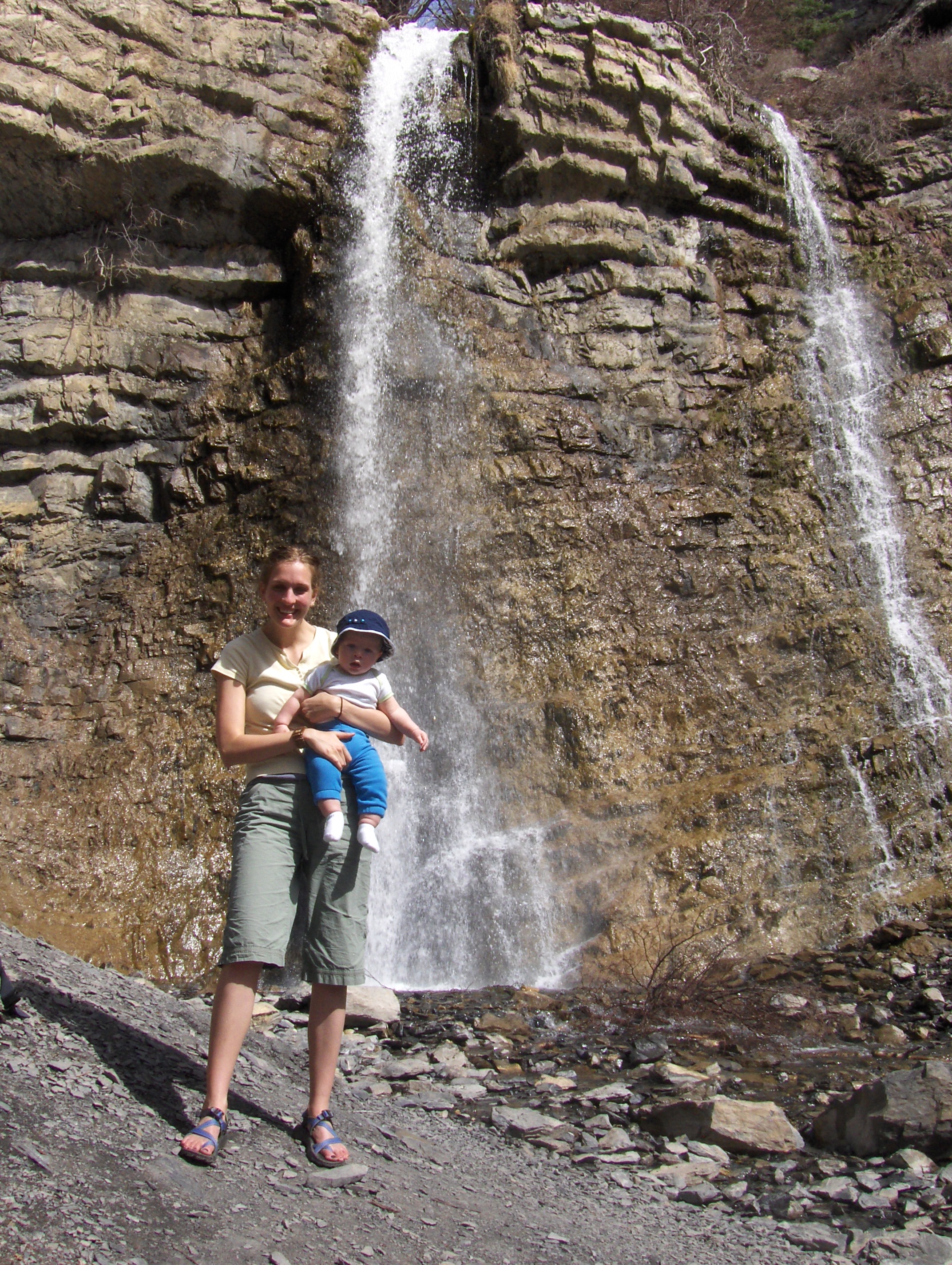
We went on our first spring hike, and I’m out of shape. It was a good thing we took a short hike to Battle Creek falls. It is my favorite hike, at least the one I’ve been on the most. Peter enjoyed it too. My grandparents live just down the street, but they had left for a trip to Israel that morning. Bad timing for a visit. Somebody did drop off some muffins on their doorstep-we thought it was a good idea to go ahead and eat them.


I also have my first garden coaching and design client! I need to do some more advertising–but I think one at a time is all I can take with Peter. It’s been a lot of fun, and I think I could do it the rest of my life. Check out my site that has been redesigned, and my blog that I actually add to.

Thanksgiving Point Gardens

I grew up around Thanksgiving Point, and actually had a season pass to their gardens one summer. This spring, I went back during the annual tulip festival with my husband. The day we went, it was very rainy. I saw three other groups out, and one bride taking pictures, who I felt very sorry for. Our umbrellas kept us out of the rain, and it was nice to go when the gardens was empty.

Now, a little background before I go into my description of the gardens. I went to school in horticulture, and worked at the Utah Botanical Center one summer. Good horticultural practices and sustainability are ingrained into me. When I go to a garden I don’t just go to see pretty flowers. I want to see interesting ideas, good gardening practices, and a bit of sustainability. Thanksgiving Point is a bunch of really gorgeous gardens. But no ideas, and lots of problems.

I did thoroughly enjoy my trip, but I also spent the entire time wondering why they couldn’t do things a little differently.

Here’s a picture of the prettyness:

Okay, now for a problem. Here is a hedge. I’m not a big fan of hedges, and this one is awful. They’ve planted yew and privet. They have grown into each other now and are quite hideous. The hedge is not flared out towards the bottom, and its resulted in a lot of die back.

I found this grove of aspen quite nice. Aspens are planted too often in places they don’t belong. They sucker, and can die back easily. Don’t put them near a lawn, and not in a little kidney-bean shaped bed in the middle of grass. This is done frequently when I live. Here, they have a naturalized garden. Suckers aren’t a problem. A disease tree can easily be taken out. The aspens can be enjoyed without the headache.

One last note on sustainability. The garden have lots of lawn, and its mostly perennial ryegrass. Utah is dry, and ryegrass takes a lot of water and other maintenance. (It’s one of the highest maintenance turfgrasses in our area). Not a sustainable choice at all. I would have liked to see ideally, not so much lawn, and at least a better choice of lawn.

Blooms

My little patio garden has daffodils! It’s about the only plant I have in the garden, so I am taking advantage of today’s Garden Blogger Bloom Day.

The forsythias are also out, and there are tons around my neighborhood. This one looked the best. Lots were overgrown, shered or otherwise neglected. I like forsythias–but they seem to be one of four plants that everyone has planted. (Roses, lawn, boxwood, and forsythias) There could be lots more plant diversity in my neighborhood.

Some of the fruit trees are also starting to bloom, along with tulips, and an Aubretia (that’s one of the flowers that the name came to me without me really realizing I knew it: I could be wrong).

I wore shorts today, and went hiking without snow. Spring is here, and what a joy after winter!

The $64 Tomato

The $64 Tomato: How One Man Nearly Lost His Sanity, Spent a Fortune, and Endured an Existential Crisis in the Quest for the Perfect Garden

I’ve been wanting to read this book for a while, and I finally got around to it. I found it absolutely delightful. It’s not a how-to-garden kind of book, but rather a memoir about the author’s experience with his kitchen garden. Any garden advice you do glean from it isn’t bad–he’s done his research–and in some ways I find it more useful to see what someone has done, rather than have someone tell me how to do things.

Does the tomato really cost $64? So, he itemizes his garden expenses, subtracts the value of the other produce based on produce stand prices, and assigns the reaming value to his brandywine tomatoes. If you didn’t need an electric fence for deer, the value would go down tremendously.

Weeding

I think weeding is one of  the most hated garden tasks, but it doesn’t have to be that hard. One of my professors taught me to love weed science. (And yes there is a science behind. You can get doctorates studying weeds. So don’t feel dumb if you have a bad weed problem.) Give me a field full of weeds and I will conqueror. Or at least fight pretty hard.

So, your weeds have gotten away from you, where do you start? For starters, I usually consider starting over. A good weedwhacker can make the first dent, then come back with a tiller or herbicide. Spray it all down, till it under and do something else. If what I had before was weedy, it can easily become weedy again. If I did want to keep some plants the weeds are chocking,  just get rid of what you can see. Don’t worry about roots. If I started to worry about roots I might never get past the first couple of weeds. When the weeds start to come back, they are usually more manageable.

Here are also some good questions to ask:

  • Why is the weed there?
  • What conditions encourage growth of the weed?
  • What will be there if we kill the weed?

I think you can choke out the weeds  or let the weeds choke out your plants. Here are some tips to make weeding a little easier:

  • Weed early and hard.
  • Use mulch. Any type of mulch helps. (Except low quality weed fabric. Hate that stuff.)
  • Herbicides are useful. I’m all for using less chemicals, but herbicides can save hours in a week and they’re not as toxic as other pesticides.
  • Use good tools.
  • Plant something to take the place of the weed.

And if the battle seems lost, there’s usually two option. One,  accept the weeds. Bindweed will hardly every be eradicated. (50 yr seed life, and 10 feet deep roots, it’s not going anywhere). Tall fescue in kentucky bluegrass really doesn’t look that bad, provided your not a golf course superintendent. I wouldn’t leave five foot tall prickly lettuce, but weeds are always going to be there.

The second option: spray everything with glyphosate (round-up), and hope your weeds aren’t resistant. If they are, spray something else. Sure, it really isn’t the eco-friendly way to go. But I don’t think a large infestation of noxious weeds is either.

Moved

I am now living in Springville. Joe is working for a security system company doing tech support. Peter has cut his first tooth, and is wearing 12 month clothes. It’s been quite busy recently.

Funny thing about living in Springville. I went to church, expecting not to know anyone, and I ended up in the same ward as my high school science teacher. She is one of the best teachers I have ever had: I took multiple classes from her, worked as her TA, and she was the advisor for science club of which I was president. (I’m a science geek if you didn’t know that about me). She is also one of the reasons I choose to go into horticulture, which is why I went to USU and why I met my husband. It’s fun how life works out like that.