
Eating Cucurbit Leaves
My parents vegetable garden did not look so hot this year. Cucumber beetles and squash bugs ate the cucurbit crops. A recurring pest of pocket gophers decided to eat the tomatoes close to the ground. The squash was attacked by powdery mildew. One zucchini and tomato ended up dying before the season was over. There were wilt diseases present.

I gave my parents some recommendations on how to overcome the pests. But nothing was sprayed or done to control the pests even at its worst. And you know what? The garden came through. There was still good harvests, including the largest cantaloupe I’ve ever seen. Maybe the harvest wasn’t as plentiful as it could of been. But it was good enough. Plants and nature can often take care of themselves, even against seemingly impossible enemies. I don’t think we need to worry about pests as much as we do.
The garden has been in the same small plot for 16 years. It is moving next year. That should help the vegetables continue to have good harvests.
Quackgrass
I hope you never come across this plant. I’ve been helping my grandma out with her garden. In her berry patch was lots of grass. Grass that you couldn’t pull up and it chocked out all the berries. At first I thought it was the lawn grass spreading over its bounds. That would have been a lot nicer. Instead it was a mean stand of quackgrass.
Quackgrass grows in irrigated soil. It has tons and tons of undergroudn rhizomes. If you come across this grass, the worst control measure is to till. Tilling cuts up all the rhizomes into smaller pieces and does a wonderful job of propagating the plant. That’s opposite of killing the plant.
So after I figured out it was quackgrass, I started to think of control measures. Here is what I ended up doing:
I fertilized the plant and made it really happy. Sounds strange. The philosophy behind that is that quackgrass’s rhizomes have a lot of dormant buds. They will just come back even if you spray or pull it up. By making it happy, I hopefully made those dormant buds send up shoots. I waited about a month, then I sprayed it with glyphosate. I did it again in two weeks. That actually did a fairly good job of killing off the plant, but I really don’t want it to make a comeback.
The next step was hand-digging out all the rhizomes. This took a long time. I’m not done with the large patch I’m working on yet. But…to see soil that you could work with and rake through after I was done was worth it. We could plant in it now…but I think we will wait. The next few months I will be watching the bed, looking for quackgrass to make a comeback. And I plan to nip out all the attempts.

This is the soil full of rhizomes. The grass isn't deserving enough of a picture.

We dug out two huge garbage bags full of rhizomes for a 8'x15' area. Wow.
The moral of this story is–learn to recognize your weeds. This weed wouldn’t have been such a problem if it was controlled when it started to invade, not years after. Also, by knowing what it was, I was able to choose good control measures and avoid ones (like tilling) that are ineffective. If you live in the west, Weeds of the West
Wadsworth Creek
Have you noticed the fall leaves? I started to see red on the mountains and started itching for a hike. This Saturday, my little family took a long hike up hobble creek canyon. We went on the Wadsworth Creek trail, which was pretty empty, not too steep, and gorgeous. So beautiful. We ended up hiking anywhere from 8-10 miles. I hardly noticed we went that long–there was something new and colorful and interesting around every corner. We reached a grove of cottonwoods and bluegrass. (I’m a little wondering how they got there–neither are native.) Peter had fallen asleep by then, and we placed him in the hammock where he was rocked so deeply into sleep he didn’t noticed when we took him out and put him back in the hiking backpack. Joe and I had lunch, and then he suggested we lay down and take a nap. I actually slept a little too, with my head on my husbands shoulder. I thought that heaven must be like this.
Why Visiting Nurseries Ruins Garden Designs
The vague inclination I had to put strawberries in the back garden suddenly took fruit after a visit to a local garden center. My husband and I were on our way to visit family and had some extra time. What better way to spend it then visiting a garden center? We went to Cook’s Farm & Greenhouse in Orem, UT. This is the very first nursery I remember visiting as kid to pick out starts to plant in our family vegetable garden. I enjoyed it then, and I still enjoy it now.
They price everything (at least the herbaceous smaller stuff) based on the size of container it is in. Very convenient from a consumer standpoint. (Too often I go to garden centers and can never find the price, hoping that when I check out it won’t be too outrageous.) Otherwise, the greenhouse has a good layout, and they also sale produce. (I was thinking that selling produce would be an excellent way to extend the season at a garden center. I’m glad somebody actually does it). I was browsing through all the plants, mostly uninterested, and happened upon a very large six pack of Albion strawberries.
I purchased the reasonably prices strawberries. Then I had to go home and figure out where to put them. That resulted in digging up my coral bells, moving them over to the newly dug out bed, and replacing the space with my strawberries. That is never what I had planned, but I like it. And I’m super excited to have fresh strawberries.
(Side note: I did an undergraduate project on strawberries and grew a 300 ft row. That year I had all the strawberries I desired. And evie-2 was my favorite variety, but not easy to come by.)

I want this tree


This is a Golden Variegated Eastern White Pine (Pinus strobus ‘Areo Variegata’) I was unaware that pines could be variegated. The effect of the variegation is stunning. I found this tree on a recent visit to the Utah Botanical Center, over at the Varga Arboretum. It wasn’t the only tree I was impressed with.

I have long loved Bald Cypress (Taxodium distichum), but this variety ‘Cascade Falls’ makes it easy to fit in a residential landscape. Bald cypress is a swamp tree–and yet here it is growing in a water-wise arboretum. Highly adaptive and quite unique. This tree is actually deciduous–it will turn red and lose its needles in the fall.
Many times in my visit I found I knew the species tree, but not the cultivar. The cultivar was what impresses and I began to realized that I need to learn cultivars not just species. But oh what a daunting task that is.

This is Diablo ninebark (Physocarpus opulifolius ‘Diablo’). It’s not an uncommon shrub–but I’ve never seen it pruned up to tree form, exposing exfoliating bark. I was unaware this shrub had such beautiful bark.


This is Lacebark Pine (Pinus bungeana). A more open pine, but that allows a clear view of the bark. This would be great in the winter, or any season for that matter.
The Varga Arboretum is still under construction. I almost didn’t find a way in–but it was worth it when I did. When I worked at the UBC, I wasn’t even too aware of it’s existence (although at that time it was more a holding place for trees, not somewhere to visit). It has well labeled trees that give the botanical and common name, the year it was planted, and water use. They have unique trees, but some more common ones as well. It’s a great place to go and look for trees to use in your landscape.
One final tree. I would never plant this, but it made me laugh. This is Weeping Treadleaf Arborviatae (Thuja occidentalis ‘Filiformis’)

It’s the Cousin It of trees.
*Side note: anyone know of a good place to order bulbs?
Vacation
We survived our vacation, and enjoyed most of it. Trips are much harder with a kid in tow. Everything took longer to do and so we didn’t do as much. But it was still very enjoyable. First we had to stop by a couple of public gardens that were beautiful. We went up to Logan and visited lots of family and friends, kept going to Grand Tetons and camped two nights. It rained, but not when we were putting up or taking down camp. Just the whole day we had to go out hiking and visit places. We went hiking anyway, but not quite as much as we might have. The one trail we went on was across a lake, up to a fall, and back around the same lake. We saw a moose + baby on our way back, and it stopped raining.
We visited my brother who moved up to Powell to go to school, and back home taking one final stop at my wonderful grandparents. It turned out to be a great trip. I decided not to really plan it–we had a direction and that’s about it. As it came close a lot of the plans just came together. It was fun and a nice break from home.
Ogden Botanical Center
My family went on vacation last week, and I was able to stop by a couple of gardens. One stop was the Ogden Botanical Gardens, located in Ogden (I bet you didn’t guess that). They had a cottage garden feel, and were very full of color. They are run by USU extension and have a education building, along with the park and gardens. There are classes, plant sales and other events, along with very helpful people there to help you out. Well worth the small side trip.
They did use a lot of annuals, but mostly in the front to add color. Those beds were gorgeous, and I like the use of the large variety of flowers all growing in and around each other, just packed with color. Further on, there were rose gardens (not my favorite, but fun if you like roses), perennial beds, shade gardens, and lots of pathways to meander down. It seemed to have a more naturalized feel: nothing was heavily pruned or maintained but still very pretty. They used a lot of warm-colored flowers which worked wonderfully to make a bright-feeling garden. After seeing this garden I am much more likly to use annuals (they just bring color in you can’t get any other way), and also let things go a little more naturalized.
Soil Texture
Everyone should know their soil texture. Soil texture is the amount of sand, silt, and clay in a soil. Sand, silt and clay refers to the size of the soil particle. The texture affects most soil properties such as water relations, nutrition, compaction, and structure.
This is how you can classify soil texture, known as the texture triangle:

From USDA--NRCS
To get accurate measurement of sand, silt and clay particles it takes more skill than the average person has. But approximating works just fine. There are two easy ways to determine soil texture. The first is filling a jar with half soil, half water, shaking it up and letting it all settle out. The layer on the bottom is sand, the middle is silt and the top is clay. The texture triangle will help you determine the type of soil you have.
Here’s another useful method that takes less time (the jar method takes a whole day). I’ve seen people get very different results, but it’s not bad to determine a ballpark texture.

I hope you all tested your soil and came up with something close to a loam. That’s what we all want, and if you don’t have it: ADD ORGANIC MATTER.
*Ink and Penstemon recently had a couple of great posts about soil. That’s why I put this up.
Steep Hike
My little family went on a hike yesterday. We actually got out of the house before 9:00, which is doing pretty good for sleeping in until 7:00. Here is where we went on the USGS Springville map. It’s located at the east end of center street in Springville.
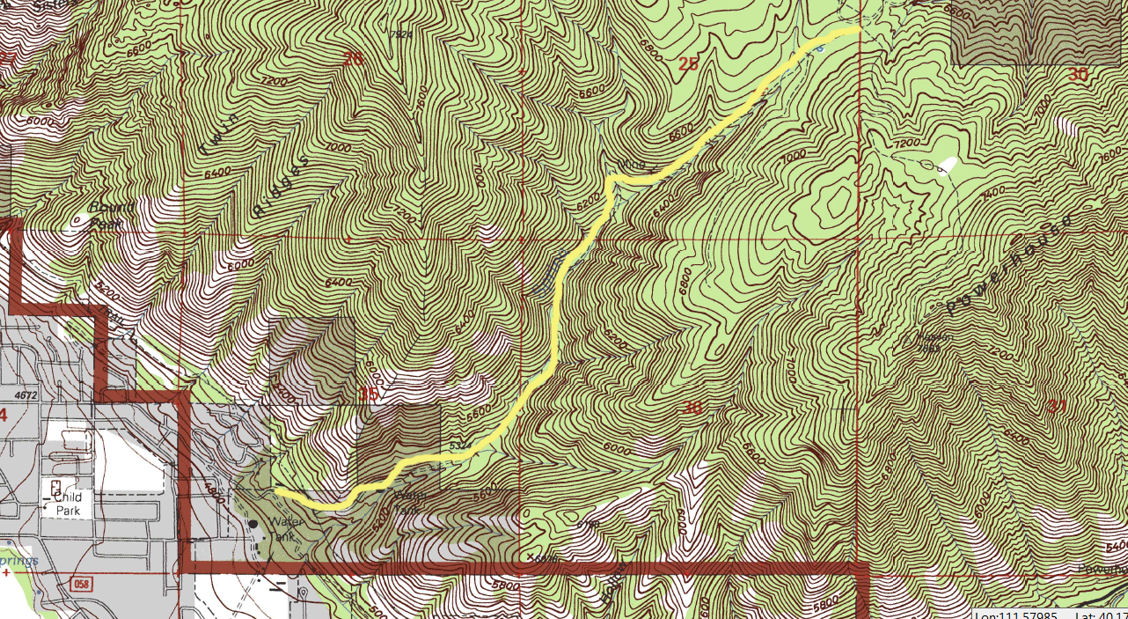
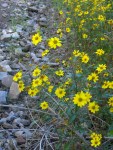
Based on my rough interpretation of the map, we climbed 1,000 feet in 2.5 miles. In other words, it was very steep. I have no idea what to call this hike: it certainly isn’t that popular (we were the only people on it on a Saturday). The only reference I found on a google search called it Spring Canyon. It does say “spring” on the map, but it doesn’t really call the canyon “Spring Canyon”. But the hike, as mentioned before, was steep. Most of the way up it was pretty shady, although not all that pretty. Scrub oaks dominated, with an occasional maple and rare mountain mahogany. Under-story plants included lots of lupine, a few penstemons, DYCs and grass (most past bloom). At the end, we started to get into more of an aspen forest and the grasses were still green. Much prettier. We stopped when we made it to the end of the trail: there’s a couple of different lookouts you can go to, but we were done and had no desire to hike another mile.





Peter kept me going a little. Joe carried him, but he hated slowing down and stopping, so we didn’t. I haven’t worked out so hard in a long time and it felt good. The shower after for my stenchy body was even better.
This week is vacation week, as Joe is in between semester. And he did very well his first semester of grad school, even while working. We will be going up to Wyoming. I’m excited. Peter should be too, but he has no idea it’s his last night in his crib for a few days…I hope he enjoys the traveling. Or at least tolerates it.
 Liz Braithwaite