Soil Texture

Everyone should know their soil texture. Soil texture is the amount of sand, silt, and clay in a soil. Sand, silt and clay refers to the size of the soil particle. The texture affects most soil properties such as water relations, nutrition, compaction, and structure.

This is how you can classify soil texture, known as the texture triangle:

From USDA--NRCS

To get accurate measurement of sand, silt and clay particles it takes more skill than the average person has. But approximating works just fine. There are two easy ways to determine soil texture. The first is filling a jar with half soil, half water, shaking it up and letting it all settle out. The layer on the bottom is sand, the middle is silt and the top is clay. The texture triangle will help you determine the type of soil you have.

Here’s another useful method that takes less time (the jar method takes a whole day). I’ve seen people get very different results, but it’s not bad to determine a ballpark texture.

I hope you all tested your soil and came up with something close to a loam. That’s what we all want, and if you don’t have it: ADD ORGANIC MATTER.

*Ink and Penstemon recently had a couple of great posts about soil. That’s why I put this up.

Steep Hike

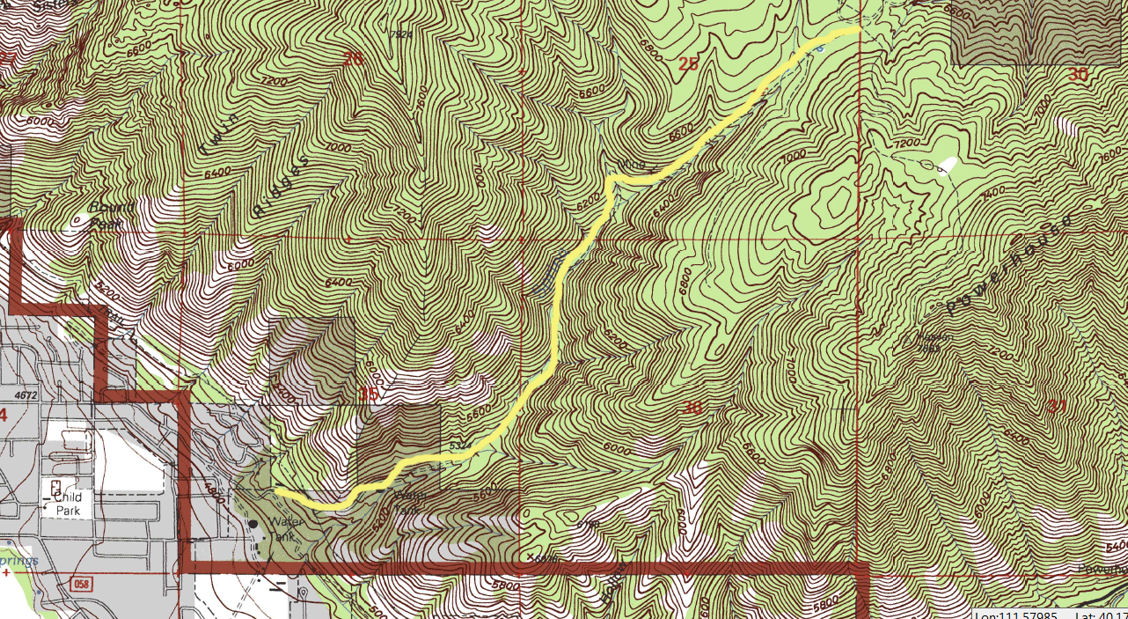
My little family went on a hike yesterday. We actually got out of the house before 9:00, which is doing pretty good for sleeping in until 7:00. Here is where we went on the USGS Springville map. It’s located at the east end of center street in Springville.

Based on my rough interpretation of the map, we climbed 1,000 feet in 2.5 miles. In other words, it was very steep. I have no idea what to call this hike: it certainly isn’t that popular (we were the only people on it on a Saturday). The only reference I found on a google search called it Spring Canyon. It does say “spring” on the map, but it doesn’t really call the canyon “Spring Canyon”. But the hike, as mentioned before, was steep. Most of the way up it was pretty shady, although not all that pretty. Scrub oaks dominated, with an occasional maple and rare mountain mahogany. Under-story plants included lots of lupine, a few penstemons, DYCs and grass (most past bloom).  At the end, we started to get into more of an aspen forest and the grasses were still green. Much prettier. We stopped when we made it to the end of the trail: there’s a couple of different lookouts you can go to, but we were done and had no desire to hike another mile.

Peter kept me going a little. Joe carried him, but he hated slowing down and stopping, so we didn’t. I haven’t worked out so hard in a long time and it felt good. The shower after for my stenchy body was even better.

This week is vacation week, as Joe is in between semester. And he did very well his first semester of grad school, even while working. We will be going up to Wyoming. I’m excited. Peter should be too, but he has no idea it’s his last night in his crib for a few days…I hope he enjoys the traveling. Or at least tolerates it.

Landscape Contractors

Recently, a weedy duplex near where I live received attention from a local landscape company. Within a few days, they had removed the weeds, put in some sod, various other shrubs and plants, and plenty of bark and rock mulch. This was all in mid-July, the hottest time of the year, but with proper irrigation it has all flourished and nothing is dead.

It’s nothing tremendously special, but a thousand times better than the weeds before. I wish they would have at least buried the rocks a bit so they look more natural, but no real complaints. The narrow park strip in this property was also dealt with well. I hate grass in park strips. Perennials are a good option if you have the room. But if the strip is narrow, I like this:

Rock mulch. No irrigation to water the cement, and no plants to get tramples and die. Narrow park strips just aren’t that functional. The only other option I would consider is low ground covers that can take a bit of traffic with a drip system. But the rocks are a lot easier.

Landscape contractors aren’t the cheapest way to create a garden, but they are fast and easy. Landscapers (good companies) also know what they are doing and avoid a lot of mistakes. They uses good plants, put in a decent irrigation system, and (hopefully) plant everything properly so it doesn’t die right off. The professionaly landscaped yards tend to have the same look about them around here. Curves, shrub beds with bark mulch and only a few different types of plants, and lawn. It’s better than what I normally see: lots and lots of lawn with teeny tiny planting beds.

Someday I will inspire someone to have only a bit of lawn and lots of neat plants. And it doesn’t have to include curves. (Not that there is anything wrong with curves. Just landscaped curves are so predicable and boring.) Or even better: I can do it myself. I will celebrate the day I get a house with a yard: and I won’t go out and hire a landscape contractor.

Harvest

This is one of the best times of the year. The heat has started to abate, but most of all it’s time to harvest. My harvest is smaller than in previous years (I had less space), but I’m quite pleased with it. I picked my first couple tomatoes yesterday, and ate one like an apple. Certainly not the best tomato I’ve ever had but still delicious. I’ve made ratatouille twice this week, with eggplant and pepper from my own garden and zucchini from others. (No need to grow that myself. I keep turning down requests to take even more than what I have.)

Ratatouille is my favorite dish from the garden harvest. I craved it in the spring and resorted to buying rubbery grocery store eggplant. Ick…should have waited until harvest. Now is when I can make as much as I want (almost) and eat to my heart’s content. My garden has most of the fixings: eggplant, tomatoes, peppers, herbs. All I need to add is zucchini, onion, garlic. I was just about to write what I did tonight in recipe form, but I can’t quite translate it. You will get a paragraph instead. I cut corners when I cook and try to do everything as easy as possible, so feel free to elaborate the idea.

I put butter in the bottom of a crock pot, and layered slices of tomatoes, eggplant, peppers and zucchini.  I sprinkled that all with garlic salt, Italian seasoning, and dried chopped onion. (Told you I cut corners. You could use real onion, etc.) I have no idea how much of each, just put on what looks good. Bake on high for 2-3 hours. I let it cool down, and used it to top toasted bagels, but have eaten it by itself, and on top of pasta.

Enjoy your harvests!

‘You Grow Girl’ Book Review

http://rcm.amazon.com/e/cm?lt1=_blank&bc1=000000&IS2=1&bg1=FFFFFF&fc1=216011&lc1=391F5A&t=ginkggarde-20&o=1&p=8&l=as1&m=amazon&f=ifr&asins=0743270142

I picked this book up at the library while I was browsing the gardening section. I had come upon Gayla Trail’s website before but didn’t really find much to interest me. I wondered if the book would be worth a read. I checked it out anyway, and ended up nearly reading it cover to cover.

It’s not a book I want to own, but it did make me think about how I garden. I was right in the intended audience: young, female, with a small space to garden in and a desire to grow food. The book focused on various crafts and creative ideas more than actual gardening knowledge, which is probably why I read it. I have garden knowledge, but I’m not especially crafty. I began to think of cool ideas I could incorporate into my own small garden, and now have a strong desire to make a gardening apron (in groovy colors of course).

It’s also not a bad beginning gardening book either. I skipped over a lot of the more simple stuff, and it is definitely opinion based (rather than objective, scientific). Not a bad read if you want some creative ideas for your small garden. And the book is quite pretty.

Stewart Falls

I’m surprised I had never heard of this hike or been on it before. It was a moderate/easy 2 mile hike to a gorgeous waterfall up by Sundance. Joe and I went there this past weekend. I am not in good hiking shape, but this trail didn’t kill me. I did feel like Peter and wanted to fall asleep at the end of it.

Previous to the hike, we had a picnic at Bridal Veil Falls. Joe had never stopped there before. I’ve climbed up the cascade before (and lost a shoe doing it) but climbing up with Peter wasn’t going to happen.

The Environmental Implications of Peat Moss

I came across a section about peat moss in the book I’m reading. It mentioned the fact that peat bogs and wetlands are slowly being destroyed to provide peat to the horticulture industry. In college one of my professors mentioned that they were basically producing peat as quickly as they could harvest it. So is peat environmentally good or bad?

If my professor was right, I can buy my potting soil without having nagging guilt about destroying endangered environments. Replacements like coir, that are inferior to peat (see this), can sit on the store shelf. But it seems like common knowledge that harvesting peat is destroying environments that are irreplaceable. I’m a little confused…

With further research, I realized that this is a very complex question. It appears that in some locations, they are farming away at peat bogs and are taking away a unique, irreplaceable environmental. But others have become aware of this situation. The Canadian Sphagnum Peat Moss Association and International Peat Society were formed to help find ways to sustainably harvest peat. New methods have been researched, and it turns out that peat doesn’t have to be a finite resource if managed properly.

Harvesting peat does impact the environment. It is no different than any other farming practice. But after harvesting peat, restoration efforts can be put in place to restore the land back to what it was. I’ve come to the conclusion that both my book and professor were right. There are places where harvesting peat is destroying a unique environment. But elsewhere, they realize the environmental impact and take steps to counter it. Canada is one such area leading the movement to create sustainable practices while harvesting peat.

Next time I go to buy potting soil or peat moss, I won’t look for alternatives.  As said in this article, “Peat moss still can be considered a safe, environmentally friendly growing medium.”

Summer

Sleds make good free baby pools.

Peter loves to splash about anywhere.

Random picnics with grandparents are awesome.

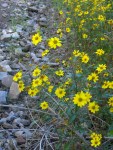
Wildflowers are out and said grandparents know where to find them.

It’s so hot. $3 swamp cooler is temperamental.

At least I have something to stave off the heat.

Meadow

For this week’s garden visit, I am taking you to the site of a beautiful God made meadow. Meadows seem to be a bit of a garden experiment nowadays, but an artificial one just can’t compare to this one I came across at around 9,000 feet above sea level. I was visiting my grandparents in Heber Valley UT, when my grandpa suggested we go on a picnic. So we drove and drove so more, and just when I was wondering what was worth driving so far for, I started to see acres of wildflowers in bloom. Apparently, according to my grandparents, this wasn’t even the flower’s peak. After lunch, my camera was heavily used trying to capture all the flowers in bloom. The photos don’t do the meadow justice, but I’ll share what I have.

To clarify–a meadow is a large expanse of mixed flowers and grasses. A meadow is a wonderful thing to want to do with a large area of land, but think twice before you do. This one is at a very high elevation, which makes a very different climate than is commonly found in a man-made garden. It’s also not prey to all the disturbance we give the land that we use. Tilling up the soil and trying to start a meadow can be just the right recipe for weeds to come in. I’ve had a bit of experience with trying to recreate this, and it resulted in weeks (I mean two hours a day, five days a week for over two weeks) of weed-whacking, heavily used treflan, and less than wonderful results. In the end it turned out alright, but not the beauty this meadow was.

Sometimes in nature there are gardens that we just cannot recreate. Instead, we need to go out and find and enjoy them.

Chemicals

I was over at Ink and Penstemon, and in a post it was mentioned that she was wary of round-up. I commented, ” I can’t imagine being scared of herbicides. To me, I would rather use a herbicide than to spend hours weeding. And I guess resistance is an issue, but maybe rotating chemicals? At least that’s insect IPM. There is more then round-up…” That kind-of makes me sound like a spray-happy farmer with no regard to the environment.  Alas, one of my faults, especially on comment forums, is being a little too blunt and lacking tact. So I come across not as I want to. For the record–I haven’t used any type of pesticides in over a year. I got pregnant, and then had a kid crawling around and it made me think a little more about using chemicals.

And now I come to my dilemma right now in my horticultural and regular mind. Are chemicals (specifically pesticides) good or bad? There seems to be two sides, and I’m a fence sitter. On one side is wary of pesticides and avoiding them at almost all costs, instead focusing on organic gardening. (Which to me is a way to garden, not necessarily just avoiding pesticides. Now I’m sidetracked–another day maybe.) The other side sees pesticides as a means to get rid of all pests, with no worries about ill effects.

I firmly believe pesticides, if used according to label directions, will generally not cause ill effects. I’ve learned a little about what goes into the testing, and the toxicity level of pesticides, and they don’t scare me that much. Homeowner chemicals are usually quite safe. And pesticides are many time more effective than any other option. In school, I knew many (some of whom came from farms) who where a little flabbergasted at the movement to reduce pesticides. Pesticides do their job economically and effectively and without any direct risk.   So on one hand, they seem to be a useful means to an end.

But that doesn’t mean there aren’t any risks. Now with a kid, I feel a little more aware of them. Certainly exposure to high levels and amounts of artificial chemicals will result in ill effects. Chemicals are everywhere, and it isn’t a big deal to get them out of our gardens, where we grow food to consume and roll around in the grass. I also cringe sometimes thinking about the amount of agricultural pesticides used to get rid of blemishes on crops. The spray happy era of DDT is certainly not something desirable.

In my mind, I’m torn between knowing that pesticides probably won’t hurt me but aware they aren’t the most friendly answer. So in practice, I use them as a last result. I am not a couple I knew who put sevin on all their vegetables to prevent bugs of unknown type and origin. But I will use a bottle of round-up to tackle the acre of bindweed (And I have faced an acre of bindweed. We did till, but that really does squat against bindweed. Actually, round-up was only half effective too.) Sometimes, I admit, I look to pesticides too early. Oh well. I’ll figure it out one day.

I believe chemicals are not huge ugly demons. Just annoying cousins. I don’t want them around if I can prevent it, but if there’s not other option, I’ll deal with it.