Abundance

I’m getting more produce from my garden each day than I have most of the summer. All the projects we have planned for this year are nearly completed, and the garden is starting to take shape. I have canned fruit, frozen salsa and still have plenty of veggies and fruit to eat. The flowers and other plants I’ve planted are thriving and looking great.

chickens
harvest
salsa
tomatoes
zinnia

I’m exhausted. The promise of winter without any garden works sounds nice right now.

Slide

I always wanted to put a slide down our hill. We finally did, and both the kids and I love it.

slide (1)

When I was looking for slides, I wanted a longer one but this one was far cheaper. Turns out it was the near perfect length. The hill wasn’t as steep as the slide needed to be, so we dug into the hill a bit. We made a platform out of a pallet we already had on had. I spray painted it with the kids, and it was anchored with some rebar. It ended up being a pretty easy project that is a lot of fun.

slide (2)
slide (3)

Now we just need to landscape around the slide, I’m not sure quite yet what we’ll do, but certainly something other than bare dirt. Any ideas?

Weed Survery

I’ve been paying attention to the weeds in my yard, even looking them up when I don’t know what they are. It started in the fall and has progressed in the summer to now. I’ve found 39 different weeds in my own yard…there might be a few more that  I’m missing as well.

I’m actually happy over the fact that I have 39 species of weeds in my yard. It’s good biodiverstiy, and I haven’t done a thing about it. Some of the weeds are edible or environmentally beneficial: I’ve got milkweed for butterflies, dandelions for bees and greens, and the chickens eat nearly everything. Most of my weeds are annuals and not widespread, so when I don’t want them it isn’t going to be a horrible task to get rid of them. For instance, the clover I seeded in the backyard has happily overtaken all of the weed species out there. The biggest problems I see in the future are bindweed and bulbous bluegrass.

My weed list (using common names from Weeds of the West):
Spring 2014
Shepherd’s Purse
Common Mallow
Dandelion
Bindweed
Puncturevine
Downy brome
Scotch Thistle
Dyer’s Woad
Redstem filaree
Annual sowthistle
Prickly lettuce
Henbit
Bur Buttercup
Catchweed bedstraw
Fernleaf Biscuitroot
Siberian Elm
Bulbous Bluegrass

Summer 2014
Black Medic
Creeping woodsorrel
Prostrate Knotweed
Prostrate Pigweed
Redroot pigweed
Showy Milkweed
Musk thistle
Horseweed
Annual sowthistle
Western Salsify
Flixweed
Lambsquarters
Kochia
Prostrate spurge
Crabgrass
Green foxtail
Bristly foxtail
Wild buckwheat
Curly dock
Common purslande
Virginia groundcherry
Bittersweet nightshade

One weed problem I’ve come across is purslane. It started overtaking my parkstrip bed I planted. Purslane is a hard weed to eliminate: it reseeds easilyand grows from small leaves left behind. In truth, my efforts to weed it out have been fruitless, it just comes back. Getting the mulch deeper has helped, and just continued hand pulling. But the truth is, I’m conflicted about this weed. I knew it was edible, and one day I started snacking on it. And I kept snacking on it. My neighbor came out and talked to me, and found me perusing my weed bucket for the delicious new shoots of purslane. I kept snacking in front of her, and actually offered her some explaining what it was. She declined and probably thought I was very strange.

puslane

I wouldn’t mind just keeping the purslane there…but this is in the parkstip bed that is mostly on the neighbor’s yard, a traditional and highly manicured landscape. I don’t think my elderly neighbors would quite appreciate the benefit of allowing a weed to take over. Good thing is, purslane is hard to eliminate and the young shoots taste the best anyway. So I can keep weeding it back harvesting heavily, and I will keep having my supply while not allowing the bed to look weedy.

Things That Worked

A new home and yard for me means a lot of new experiences and experiments. 

We moved the little chickens in with the big chickens. It involved letting them free range together, moving the brooder box close by the coop, and ultimately just throwing them all together. It was relatively peaceful actually…they still maintain two separate flocks, but they are pretty nice to each other and I never had any injuries. I think I worried more than I needed too.

chickens

I also moved the compost pile into the chicken coop. They are excellent compost turners. Although I don’t really enough material to make lots of compost the chickens are great at making branches, chicken scraps, grass clippings and even a dead bird disappear. The chickens have also turned out to be the best puncture vine control. We move our coop around, and when it is over a puncture vine patch they will eat it gone in a couple of days and it stays gone.

compost

In the spring, I bought a bag of clover seed and inoculum. One day as I was turning on the flood irrigation, I thought why not just throw down the seed and inocolum right now, while the water was flowing, and see what happens. So I hand broadcast the clover seed pretty densely and just basically dumped the inoclum into the start of the irrigation water. The area was a pretty bare patch of mown weeds, mostly winter annuals. All I did to help the clover germinate was turn on the flood irrigation when we had our turn, twice a week. Because it was irrigated, plenty of plants grew, and happily much of the clover. After mowing it once, the clover has become even more vigorous and I think by next year it will have completely taken over. Fifteen minutes was all it took to establish a small patch of clover, and I think I will replicated the process over a broader area next year.

clover

In our side area, we had a bunch of Bridal Wreath Spireas. I mentioned before that we had cut them back to the ground. I was unsure if they would come back. But they’ve come back just fine, even without consistent irrigation. They look so much better than they did, I’m glad we went for it and hacked them back.

backyard

spirea

The last little experiment was moving our dryer. It was inside and had a long vent line. The dryer worked horribly, and I was pretty sure it was because of the vent line, even after I cleaned it out. My bright idea was to just move the dryer outside on our back patio. My husband wired up a new plug and we moved it. It now takes about half the time it did to dry clothes. In the winter we plan to move it back inside, but also vent inside.

dryer

The unattractive but functional back patio complete with dryer.

We are still in the thick of many projects in our garden, and our front yard might look a bit like a construction zone right now. A few things haven’t worked so well–free ranging the chickens in the evening has meant of decrease of of tomato crop and no melons this year. Most of my squash died from an unknown cause. There are weeds everywhere. But we’ve had plenty of things go right as well.

construction zone

Removing Lawn

I recently saw my neighbor up the street removing sod. I enjoy seeing people removing lawn, hopefully to turn into more interesting gardens. We are in the process of removing the lawn in our own front yard.There are several methods to get rid of lawn, and I’ll briefly explain each one.

1)Dig out by hand: Get a good shovel and dig.
Advantages: Can remove lawn from garden and be ready to re-plant in a few hours. Lowers the grade of the soil, which is usually desirable. No special equipment needed.
Disadvantage: Grass can regrow from deeper roots. It is the most labor intensive,. Sod is often hard to dispose of as many green wastes and dumpsters won’t take it. It also take the top few inches of soil away which is often the richest part of the soil, along with the organic matter of the grass.
Best For: Small areas wanted for immediate re-planting

2)Sod cutter: This is the method my neighbor was using. Just rent a sod cutter, which will cut the sod an inch or more below the soil. It can than be rolled and hauled away.
Advantages: Quicker than digging by hand. Other advantages the same as digging by hand.
Disadvantage: Many are the same as digging it out by hand. It is less labor intensive, but has the added the cost and availability of renting a sod cutter.
Best For: Large area wanted for immediate re-planting

3)Tilling: Use a heavy duty tiller to till lawn under.
Advantages: Quick method, retains top layer of soil and the organic matter of the grass.
Disadvantages: Getting the equipment if not available. Least effective method to kill the grass, might see a lot of regrowth.
Best For: Use with other methods (i.e. after sheet mulching)

4)Herbicide: Spray lawn with a non-selective herbicide like glyphosate.
Advantages: Least labor involved. Maintains top layer of soil. Can result in the least amount of lawn regrowth.
Disadvantages: Use of chemicals might not be desirable. Lawn will often need be sprayed multiple times, and will take up to a month to die out if using glyphosate (Round-up). Also glyphosate will not be effective unless the lawn is actively growing, so often ineffective in the summer months on cool season grass, and the fall/spring months on warm seasons grass when the grass tends to go dormant. Can be unattractive.
Best For: Effective die back without lots of effort

5)Sheet mulching: Layer a layer of corrugated cardboard or thick newspaper and top with compost, wood chips, or other mulch.
Advantages: Maintains top layer of soil and will add additional organic matter. Not labor intensive. Can look attractive immediately.
Disadvantages: Will take three or more months until grass is dead and area is ready for planting. The use of cardboard is controversial and will not help with soil health.
Best For: Large or small areas that are do not need to be immediately replanting.

6)Neglect: Do not water or otherwise care of lawn, and mow to very short height.
Advantage: No labor required. Can be effective in areas with little rainfall and high maintenance lawn.
Disadvantages: Takes time for grass to die, and in the meanwhile looks awful. Often not very effective.

I often use a combination of methods, for instance I’ve sprayed followed by sheet mulching followed by tilling. My favorite method is sheet mulching, because not only does it get rid of the lawn but it also can improve the soil at the same time.

In our front yard, I started out by neglecting it. We didn’t water it and it went brown pretty quickly. Where we walked frequently, the grass died back rather quickly. It didn’t look that great though, nor was it killing off all the lawn. We put down some sheet mulch. First I mowed it at my lowest mower height. We dug out a small strip on the edges so the bark mulch wouldn’t spill over onto the surrounding pathways. It was sheet mulched with a layer of cardboard and wood chips. Looked pretty good as soon as we were done, and it’s been there a little over a month. The cardboard is taking a while to break down because it is summer: it needs more moisture to disintegrate. I don’t think we’ll be planting too heavily until the spring, and by then I expect the cardboard to be gone (along with the lawn). It is also possible to cut holes in the cardboard to plant, although grass can also re-grow through the holes if it isn’t dead yet.

Right before we started sheet mulching

Right before we started sheet mulching

Cardboard first

Cardboard first

Then add the mulch

Then add the mulch

All finished

All finished

Swale

So if you haven’t studied permaculture, and even if you have a little bit, you probably don’t know what a swale is. And what I’m about to describe isn’t necessarily a true swale, it’s more like a ditch mixed with a swale. If you want to learn more about swales, go ahead a follow this link. If you just care about how I dealt with the flood irrigation problem in my landscape, keep reading. 

Our side yard grass is flood irrigated with a water turn. We turned it on this year and noticed that with all the dips and hills in area, the flood irrigation would only water a portion of the grass. Water doesn’t move uphill. If the area was almost flat and the water came from the high point, it would have worked out a lot better. That’s how rice patties work–perfectly flat land, and then it all gets irrigated the same way. Our grass was on a downhill slope with plenty of dips and low spots that meant that originally only 1/3 of the grass was irrigated.

We noticed that at some point there was probably a ditch going to a downhill portion of grass that wasn’t getting any water, so we re-dug the ditch. But then all the water simply went down the ditch and wasn’t watering the uphill part of the grass where it started. We tried putting up little rock dams, and it helped a little but not a lot. I had been in my permaculture class and knew that we needed to build a swale: or in other words, we needed to level the ditch so that the middle and both sides were neither uphill or downhill from each other.
original ditch
We marked it out with an A-frame and re-dug the ditch.
a-frame
We were not quite successful at actually making it level, but with only one little rock dam, it finally worked. The swale would fill up with water, and because it was relatively level, it would spill over across the length of the swale instead of at just the low point. We ended up watering about 3/4 of the grass. The other quarter is simply being converted to planting beds.
reforming the ditch
Because landscaping is moving toward automated irrigation sprinklers, and we use big machinery to level everything, very few people care about contours, or level lines across a slope. But after studying permaculture, I’m learning the benefit of using contours: they create beautiful and highly functional curves. Because I’m still using flood irrigation, it is essential that I know about the contours in my landscape, because if I understand them, I also understand how the water is going to travel. And I can fix things like the flood irrigation of my lawn so I don’t have to start using culinary water.

*I realize that portions of this post might not make a whole lot of sense. If you are interested leave a comment and I can either respond and clarify, or add a video. 

Squash Pests

My squash patch decided to have an abundance of pests. I find it rather fun. I love diagnosing problems in the garden, I spent a couple internships in college doing it and got hooked.

First–here’s a mini guide to diagnosing your own pests.

  1. Consistently check your plants for damage, yellow leaves, insects or other problems. If caught early, problems are managed much better.
  2. Look for the easy answer first. Find out what your plant needs and compare it to the care you are giving it. These are generally issues like a plant in the wrong spot, over or under watering, chemical spills, etc. Most problems are caused not by insects or diseases, but the care and environment the plants are in.
  3. If you are in Utah, sign up for the Extension pest advisories. They keep you up-to-date on problems they are frequently seeing. Their site is also were I first go to start hunting for pests. It’s local, so I’m not finding problems that don’t actually exist in my area. Pests and diseases and typically regional. If you live in another state, look for the equivalent in your area. If you start Google-ing away, sometimes it can lead you down a path that has no basis in the climate and situation your are facing.
  4. Use the Extension office: but use caution. Unless you are talking to an agent or sending in a sample for diagnostics by an actual professional, calling the Extension can often mean talking to an intern or master gardener. They generally do a good job, but they are just normal people and their depth of knowledge can vary greatly. I’ve given less than great advice answering phone calls as the Extension when I was first starting out.
  5. Always diagnose the problem before spraying with insecticides or other drastic action. I’ll never forget the man who brought in a some dead insects off a tree. He had sprayed before he even knew what they were, and it turns out they were ladybug larvae.

Okay, so out in my garden, I was hunting for squash bug eggs, because I do subscribe to the pest advisories and they said to start looking. I found a whole bunch, and removed them with tape. My treatment for the squash bugs is to continue to monitor for adults and eggs and remove them when I find them. I only have a small squash patch, so it shouldn’t be hard.
bugeggs
<a tape
While I was removing the eggs, I noticed that my leaves were yellowing. This is common for watering problems, or under-fertilization, but I was pretty sure that wasn’t the problem. Closer inspection led me to believe that I had spider mites. My best options for control are insecticidal soap or neem oil. I don’t have either on hand though, so I’m going with the third option–a hard stream of water to knock off as many as I can, and continuing to take good care of the plant.
href=”http://homesufficient.com/wp-content/uploads/2014/07/spidermites.jpg”&gt;spidermites
My last squash plant problem was the sudden death of a zucchini plant. Over two days it wilted and died. I don’t know what caused it. There weren’t any signs of insect damage from squash bugs or vine borers, cultural control was the same as the surrounding plants, and I didn’t see any signs of a root rot. I’ve seen this happen before. On this page it lists sudden wilt with an unknown pathogen as a widespread problem. So I have no idea what happened to the zucchini plant, I just know that sometimes squash plants up and die for no apparent reason. It’s okay because I have three other zucchini plants.
wilt

Swings

In my city, we don’t have swings at the parks. I’m not sure why, but it did mean I wanted to put swings in my garden.

I thought of a traditional swing set. Unoriginal, and often not functional. Metal swing sets tip if not anchored, and I’ve seen lots of wood ones collapse on themselves after a few years. They aren’t very cheap either.

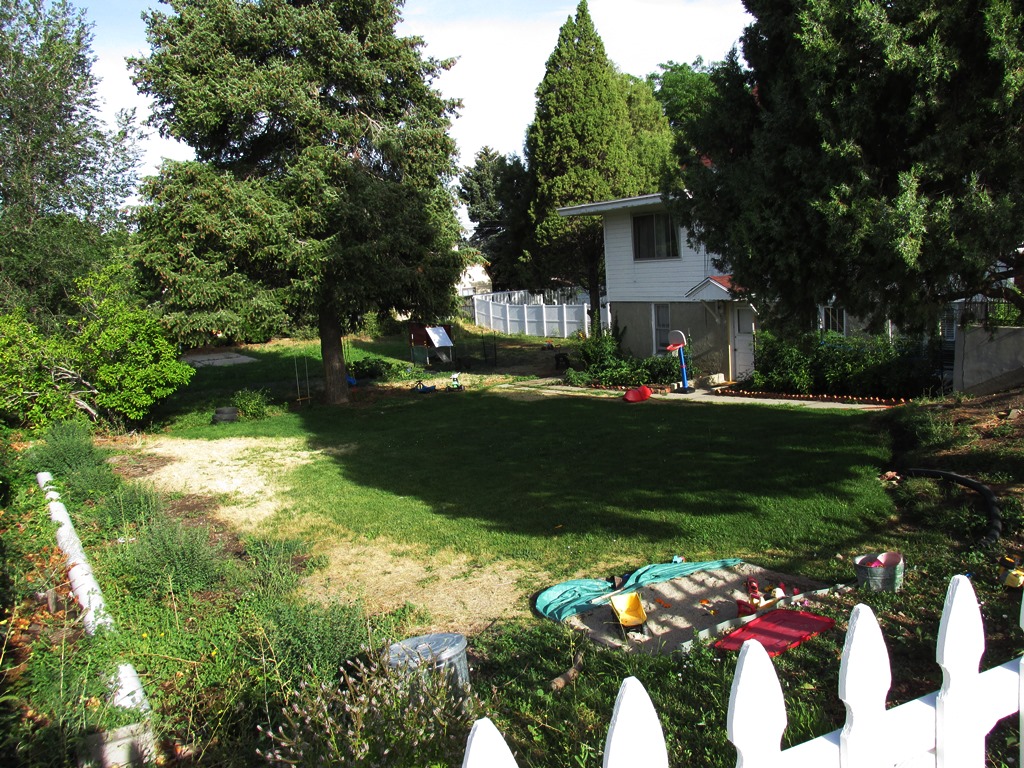
On our property is a very large Douglas Fir. I thought it would be a wonderful place to hang a couple of swings. Later on, I saw this post, and we copied the construction of the swings. One swing is a traditional rope swing, the other we attached our existing baby swing.

The whole project took one evening, a large borrowed ladder, and cost about $50. The kids love the swings. Because they are hung on high branches, they swing high and far.

The only downside so far is the tree is rather sappy. It can get shoes and shorts pretty dirty.  

swing1
cheese
swing3
swing4