Test-Tube Agriculture

I remember watching an old cartoon, set in a classic futuristic space setting. For food, they ate a single pill, full of everything needed to survive. It is a concept repeated other places as well: test-tube food. Just figure out the basic necessities of life pack it into one package and then have no worries about nutrition.

It is a reality that has fringes in our current standard diet: Ensure, formula, vitamin packed powders, and breakfast cereals packed with extra vitamins. Recently, the real food movement has pushed away from this overly simplistic science, acknowledging that we often can’t replicate the variance that our diets require, variance only found in the natural world. For the most part we still eat a wide variety of foods, and a varied diet is encouraged.

I watched this video, and started to wonder again about that test tube food. Modern mainstream agriculture is striving for that test tube approach. Figure out the right balance of nutrients, add it to crops in chemical fertilizers. Our food is becoming the result of too ridgid science, focusing not on the hundreds of nutrients in the natural world but a handful that are the most prevalent.

What we put into our food production is also what comes out. And if we are striving for test tube agriculture, the food that comes out is test tube food. It might look like a varied diet, but really often is the same  test tube grains processed in ways that simply look different. I realized at one point that  sometimes the various processed food I was eating was the same exact food, just flavored and colored to appear different.

When I produce my own food, I don’t use chemical fertilizers, or try to figure out exactly what a plant needs. I focus on natural systems, and let them do the too complex work to figure out myself. And I can see the benefit, in the yolks of my free range eggs, the taste of homegrown tomatoes, and feeling more healthy than ever during the height of harvest season. Test tube, over simplified science shouldn’t be the base of our diet, and so it shouldn’t have a place in our agriculture as well.

Bread

I had a goal to make my own bread for a long time. But I was never motivated enough to bake it regularly until I put it on my chore rotation. I bake two loaves about once a week, which is perfect for our family. Now we rarely buy bread, and I enjoy eating homemade bread consistently, as well as having it a main portion of my children’s diet. I grind my own wheat as well, using white wheat which I like much better than traditional hard red wheat.

rise mix bread

I use my mom’s recipie, that I’ve modified to fit my own mixer and tastes. It is very simple and I have good results with it.

Whole Wheat Bread

Recipe yields two large loaves

  • 3 cups warm water
  • 2 tablespoons yeast
  • 1/3 cup vital wheat gluten
  • 8ish+ cups whole wheat flour
  • 1 tablespoon salt
  • 1/2 cup honey
  • 1/2 cup oil

Grind flour if not already done. Combine warm water and yeast. Add wheat gluten and 3 cups of flour in a mixer with a good dough hook. Add remaining ingredients. Gradually add flour until dough pulls away from the side of the bowl. Turn mixer on medium high and allow to knead for 6 minutes. Divide dough into two parts, and form into loaf shapes. Place in bread pans. Preheat oven to 350. When oven is heated and dough is risen (I allow the bread to rise the same time it takes to heat the over), bake bread for 30 minutes.

I love making bread, not only because it is delicious, but because it was a goal I wanted to do and have now met. I didn’t reach my goal for a long time, but eventually I figured out a system that worked for me. It reminds me that if I give myself time and just keep trying other goals that I have will become realities.

New Nursery

We decided to turn the storage room into a nursery. Technically it was already a bedroom, but it is a very small room, and it had a cement floor and other various parts that were not finished . When we moved in, it was a clothes closet and then a place to store all the games and school/craft supplies. It made a great storage room. but we are having a baby and it made sense to turn it into a bedroom. I did not want to put a lot of money into this room, but I did want a room that I felt comfortable in.

I cleaned out all the various junk inside the room to other locations around the house. We started by installing some remnant carpet tiles for the flooring. It is mismatched flooring, but also very inexpensive and easy to install. I added some curtains from IKEA, got a new cover for my recliner, and set up the crib. Joe added an overhead light that wasn’t on a pull switch, along with another outlet. He also removed some redundant plumbing pipe. (That took awhile because he didn’t quite know what he was doing…thank goodness for a good friend that was able to show him what to do.)

nursery

Total cost was also under $175 so far, which included new flooring. The bedroom still isn’t going to impress anyone, but I enjoy it and it is a huge improvement over what we had. I wish I had a picture of the place beforehand, but it was never anything worthy of taking a picture of. It still isn’t quite done, the room needs molding and inside the closet isn’t finished. We might get those projects done eventually. For now it will work wonderfully as a nursery for our new little baby who is coming very soon.

Sometimes I’ve found it very easy to get caught up in dreaming. Dreaming made easier by the world of Pinterest, and Houzz. Before I moved into my new home, I love perusing photographs of lovely homes, saving ideas and pictures I dreamed of copying. Then I bought a house. Our house isn’t perfect. When we moved in, I was much more interested in making the house comfortable and safe than copying the ideas I saved. Projects like finishing off a threshold, installing a toilet correctly, and getting rid of anything I found hideous came first. I stopped looking for ideas, instead going off of my limited budget and own desires. I love my home now if I let myself, and I didn’t create it by copying ideas on the Internet. I am creating my home by responding to my own desires and ideas, and by often being content with less than perfect.

Sometimes I still find a blog or post that makes me want to re-do another room or abandon my simple decor and strange floor plan. I have to take a step back. I stop comparing my home to another and instead ask, “Am I comfortable here? Does my house function well for our family? Is it a place I love to be?” There are still projects I want to do, but they don’t necessarily match the goals of the wide world of home decor out there. This is my home, and the only people who need to love it is my family and me.

I re-did a nursery and I’m not getting any awards from it. But I stayed in our budget, and I’m perfectly happy with it. That’s far more important to me than to try to impress anyone else.

Fall Leaves

I don’t have any large deciduous trees on my property, so fall leaf clean-up isn’t an issue for me. But I wish it was. Leaves are valuable! I cringe when I see leaves thrown away in regular garbage (green waste is okay if you have to). Why? Well, because they are free organic matter. And organic matter is key to good soils and gardens.

How to you transform fall leaves into good soil? Here are some ideas for using them:

1)Mow. The year I did landscaping for a condo HOA, I raked only a small section of leaves. For the most part, I’d shred them up with the mower and leave them. I did it about three different times, so I never had over a couple of inches of leaves on the ground at any one time. The leaves nicely decomposed in the ground. It was super easy. This works really well for fine leaved trees like honeylocust (sometimes you don’t even have to mow those), but will also work with the thicker leaves like maples as long as you don’t let the leaves get too thick.

2)Mulch. This year, I piled the leaves nice and high around some spireas. I needed mulch there, and fall leaves are free. It also would work well in sheet mulching to smother lawn and other weeds.

fall leaves

3)Compost. Leaves can be added to a compost pile. They would act as a high-carbon or brown type of compost and should be combined with a bit of something high in nitrogen like manure, kitchen scraps or green material if you want ideal compost. (Although compost doesn’t ever have to be perfect.)

4)Annual Garden. This is probably the most common use I see: adding a nice layer of leaves to the garden. Most people till it in, which could be done in the spring or fall, but it doesn’t have to be. It would work well with a no-till garden by just leaving the leaves there and using them as mulch in the spring. The only caution is if you do till a large amount of leaves in, the high-carbon can eat up the nitrogen in the soil. Don’t do a large amount right before planting, or if you do make sure there is an additional source of nitrogen.

One of my actual fears in life is at some point I’m going to have a lot of leaves and some kind person will feel the need to rake them up and haul them away for me. I love leaves and firmly believe that they are far too valuable to end up in the trash!

Moving Furniture

We live in an old house, so it is no surprise that the floor plan is a bit hard to work with. The living area is great and I’m happy with it. The bedrooms are rather interesting. With young children, I like to be able to sleep near enough that I can hear them in the night. It took us a while to figure out how to do that. Here is the current arrangement:

floorplan


The main floor has pretty much stayed the same since we moved in. We used a bedroom off the front room for a playroom, and I love having it there.

When we first moved in, we used the downstairs family room as a master bedroom, with the kids in the bedroom one. Bedroom three is very small and was unfinished, so it became our closet. The attic room was our school room, where I set up all our school activities and other toys. It worked, but the family room just didn’t make a very good bedroom.

The downstairs family room was converted to the school room, where it remains. We moved the master bedroom upstairs to the attic room. It was a lovely bedroom but had several fatal flaws. Attics get hot in the summer. The nearest bathroom was down a flight of steep stairs (and I became pregnant). We were also two flights of stairs from our kids. Although they generally slept through the night, we still used a baby monitor and occasionally had to go down two flights to comfort a child.

Now, the master bedroom is in bedroom one. We moved the boys to bedroom two, and have been working on finishing up bedroom number three for a nursery when the new baby comes. It is not perfect. All of the bedrooms downstairs are pretty tiny, but it works. Eventually when the kids are older they will probably move up to the attic room and have more space. (The room is currently a guest room and place to put everything that doesn’t have anywhere else to go. It isn’t used much.)

We ended up moving a lot of furniture in the process. I’m glad my husband has put up with all my requests to occasionally move a large bed up or down two flights of stairs.

Why I Love Having Chickens

I always wanted chickens, they just seemed like a useful pet. I haven’t been disappointed either. I recently read an article about food waste, and didn’t feel guilty in the slightest. We’ve basically eliminated all our food waste by having chickens. I keep a bucket in my kitchen for all the food scraps. If we don’t eat it, the chickens usually do. We even gave them the mouse that we trapped after it came in our house. In return the chickens give us the obvious eggs. But they also process compost, adding fertility with their manure, and do a great job of weeding and prepping soil.

We have seven chickens. Three are currently in full production, and the other four are just starting. They will lay anywhere from 2-5 eggs a day right now. We still occasionally have to buy store bought eggs to keep up with how much we eat. but I don’t like to. Regular eggs at the store are not expensive. If I were do do a purely economical analysis, I doubt the eggs I get from my chickens would be cheaper. So why do I like my own eggs better? I find a lot of satisfaction in getting fresh eggs from chickens I’ve raises, and know I’m not dependent on the grocery store. More importantly, the eggs are different. I don’t notice a huge difference in taste, but store bought eggs look sickly compared to the eggs from my pastured chickens. Here’s an example:

eggs

I was frying eggs and used a few from the store and a few from our own chickens. The ones from our chickens (if you didn’t guess) have orange yolks. The deeper color comes from a more varied diet that includes our table scraps, bugs, and greens in the field. The varied diet is transforming into better nutrition in my eggs. I don’t think of egg yolks as yellow anymore: they are properly orange.

A Store

In the downstairs family room, I’ve set up a school room where I do preschool with my two boys, along with a co-op group once a week. I love doing preschool activities. When I was considering signing my older son up for a formal preschool, I decided not to in large part because I love doing preschool with him.

Last week, I set up a store for the kids to play in. I think I liked creating it as much as they liked playing in it. (They did like to play in it too.) It wasn’t anything fancy, just some dollar store items and quickly made signs.

store

We like having our school room downstairs and we play in there at least every morning. I rotate out the toys and activities that are available there. The kids usually pick what they want to do. My oldest loves worksheets, and the toddler loves play-dough. I love being able to pretend I’m a kid again too and enjoy the slipperiness of slime or re-learning about the parts of a plant.

Backyard Swales

In the backyard, I wanted a place to extend the garden with vegetables at first and more perennial crops like a food forest later. I wanted to take greater advantage of the water turn, not spend a lot of money, and also make it look nice. What I ended up planning on was two beds on contour (or flat), with a ditch or swale in front for the water turn, and a hugelkultur mound behind. I’m going to walk behind what we did so it makes sense.

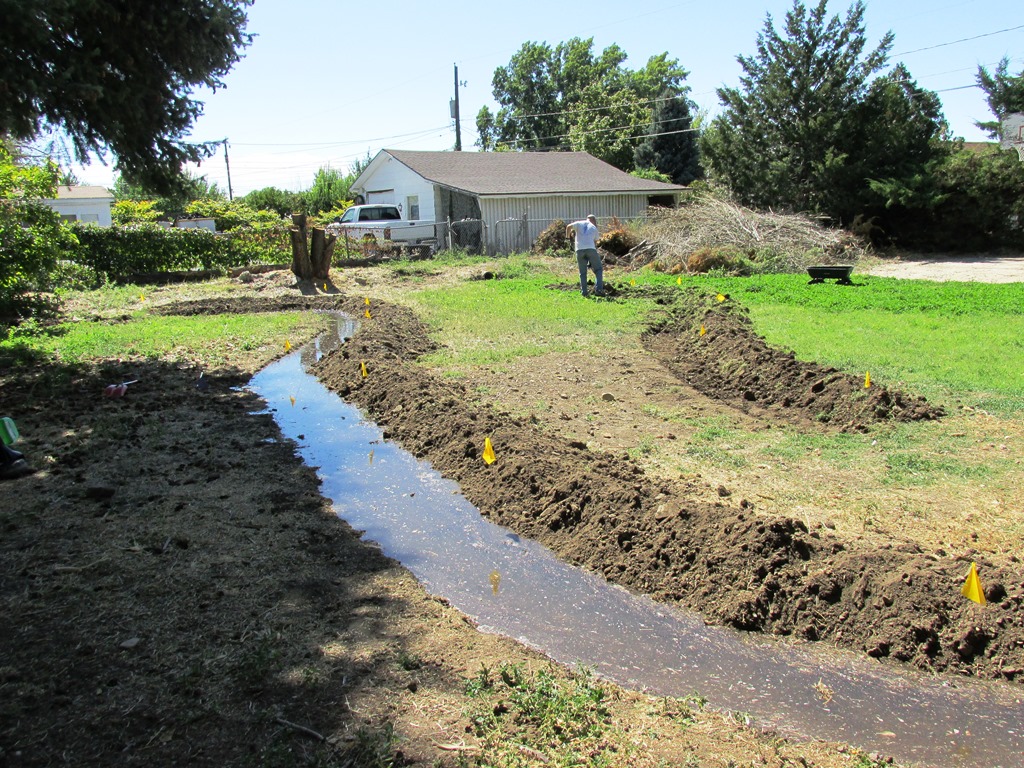
First we used a transit level to mark out a level line, or a line on contour in the landscape. It’s marked with yellow flags in the pictures. Our backyard is pretty flat, but it still has a lot of hills and flat spots you don’t see unless you are out there with the level. The line we marked was nice and pleasingly curved. Several time Joe asked if it was really necessary to worry about an inch in grade. I said yes. Getting the first line right on contour both made for nice curves and made the water flow far more even than it would have been otherwise. If it wasn’t exactly level, we might have had to go back and re-dig or dam some areas up.

step 2

Next Joe dug up the downside part of the line we marked out. He dug about three feet wide and maybe a couple of feet deep. We then filled up this area with various sticks and logs we had on hand, and put the soil back on top. The rationale behind burying the woody material is it will break down and gradually add organic matter to the soil. It is often referred to as a hugelkultur bed. In drier climates, I think it is important to do this in the fall to give the woody material time to break down over the winter: otherwise it can strip the plants of nitrogen. For us, it was also an easy way to get rid of at least some of the large pile of shrubs and trees we’ve removed (pictured in back by the basketball court).

step 3

Joe dug a trench in front of the woody beds, piling more soil on top. This created a ditch or swale to let water flow down. The swale is flat, and is fun to see fill with water. Instead of the water just rushing down, it fills up gradually and soaks into the the area. It both channels our water turn, and collects rain water. We’ve had lots of rain, and filled it with irrigation water and it is doing the job.

step 4  water

full

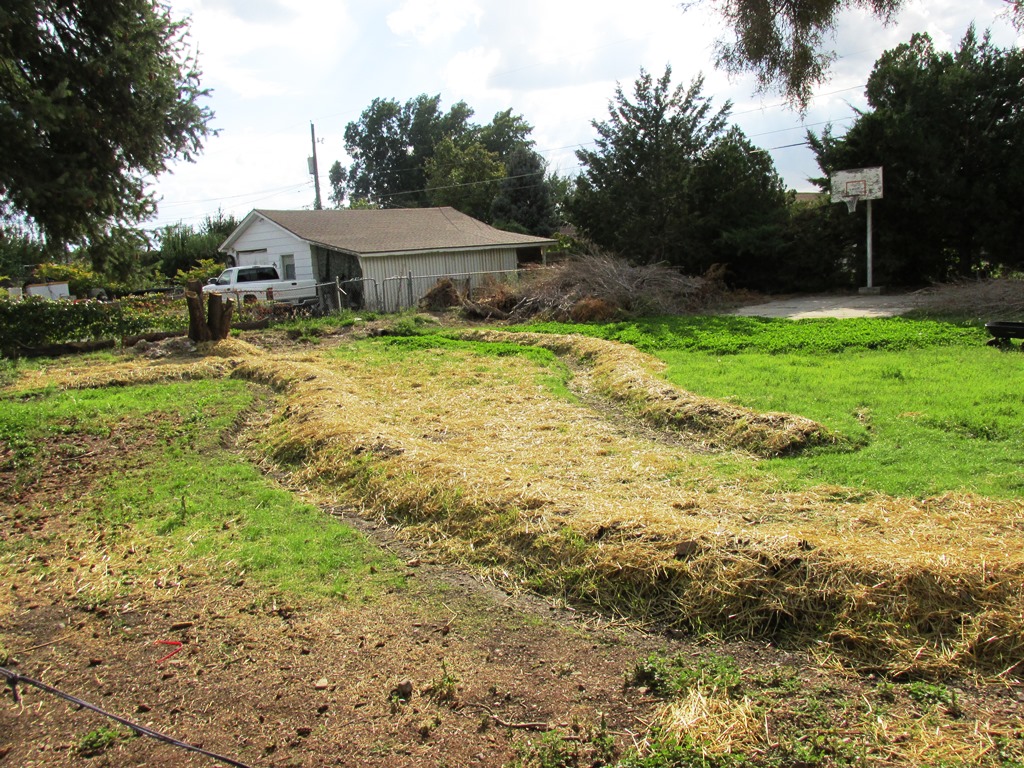
After the mounds and swale were dug, we seeded the mound with a cover crop that included Austrian field pea, hairy vetch,  winter wheat and winter rye. I also put clover down where I wanted something more perennial. The seed was raked in and covered with a light straw mulch.

planting

completed

Next year I will start planting with a wide range of edible plants. I’m hoping it will be a better environment for my squash that were in the same area but all died this year using traditional agriculture practices.

This is completely new territory for me. It isn’t a far stretch in permaculture circles, but outside of that I have to explain in detail what I am doing and why to anyone who sees it. It remains to be seen if this will be a highly productive system or not, but I have high hopes. So far, the cover crops are coming up great.

Weber Basin Garden Visit

Recently the Weber Basin Water Conservation Learning Garden (they need a shorter name) had a garden fair, and I thought it would be fun to go down there. I haven’t been there in years, and it has matured nicely since a visit while I was in college.

This slideshow requires JavaScript.

I’ve been looking at permaculture methods for so long, I miss the water wise gardens that I used to work in/look at and love all the time. They aren’t exclusive at all either–permaculture just often forgets to make things look nice along the way of creating super productive gardens. Solely focused water-wise or xeriscaped gardens don’t.  It was a good reminder to me that even if I am exploring and working with permaculture, I can still remember to make the gardens pretty and not just productive.

Quick side note: A water-wise garden primary focus is to conserve water. It often includes edible gardens, native plants and other good gardening and environmental practices, but it zero-ins on water conservation the most. Many times, a water wise garden will simply tweak traditional garden practices to conserve water more. A permaculture garden would also include water conservation, but the primary focus is the three permaculture ethics: care of the earth, care of the people, and return of surplus. A permaculture garden tends to have more food production and doesn’t follow traditional gardening at all, but instead mimics and builds upon natural landscapes.