Where the Harvest Went

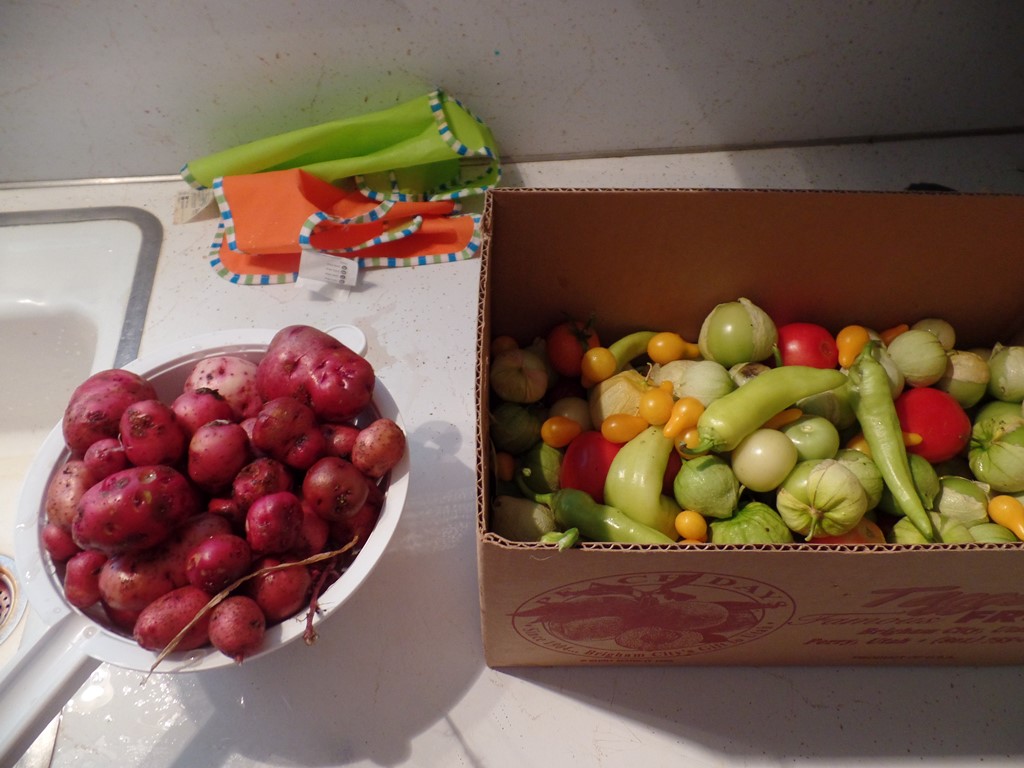
I had an overabundance of tomatoes, and not enough of everything else. The tomatoes are still alive even: it is odd to still have tomatoes in November here. I guess it is just making up for the late start I had with them.

I had a friend post her canning activity, and I was saddened because I felt like I hadn’t done anything. In reality, I did plently. I was just a bit lazy about it. Here’s what I have

cans

My mom came to my house with apples from her trees and made me twelve quarts of applesauce. It was awesome. Moms are great. I also made about 12 quarts of tomato juice. I don’t drink tomato juice, but it does make some pretty awesome tomato soup. I’m sad because I didn’t do peaches this year. We had a peach tree in a community orchard, but it froze. I didn’t can tomatoes, because I still have some from last year.  I made a grand total of one quart of pickles, but otherwise the cucumbers didn’t do well.

I froze a lot. It’s simple, and I’ve got a chest freezer to fill up anyway. There’s about 8 bags of grated zucchini, 15 or more bags of salsa, three bags of marinara, and another 12ish bags of whole and crushed tomatoes. We had as many tomatoes and tomatillos as I wanted. I simply stopped picking them after awhile. I also have a winter squash to break open and freeze soon.

Not a bad year. I think it’ll last me awhile. But next year: less tomatoes, more of about everything else.

Insipiartion

We went to the Denver Botanic Gardens on a recent vacation. It was beautiful and filled with different styles of gardening, good ideas, and lots and lots of plants. My husband was impressed with a crevice garden, I enjoyed the Bonsai. Here’s a sample of pictures.

I’ve always loved public gardens and recommend that people go to them. They are a great place to get inspiration and to see plants in person. If you go to one that is nearby or similar in growing conditions to what your own garden is, you can walk away with a great plant list, and know that the plants will probably do good in your own garden. It’s a far better way to find plants than just looking at nursery tags or even in books. I live in Utah, but we are very similar in climate to this Colorado garden. There were more short grass prairie plants than I often see around here, but I don’t think it is because they won’t do well here, just that people don’t utilize them as much as they could. I really want to put blue grama grass somewhere on my property; this plant was used in several different ways at the gardens.

My garden is nowhere close to looking like the gardens there. It was established in 1951, so it makes it 62 years older than my own garden. Gardens are just very slow to develop and establish properly. Even if you have lots of time and money (which I don’t anyway), plants can take years to establish, and re-evaluation needs to be done constantly. Gardening is an art with living forms, where the artist does not have full control but works within the constrains of environment and the results takes years to achieve.

Review-2 Years

We’ve been in our home two years. I don’t feel like I’ve been there that long. Here’s what we’ve done in two years:

Garden

Inside

I’m pretty happy with everything we’ve done, but we have tons to do still. I think I might live here for a long time, just because it will take me that long to finish everything I want to in the home. Hopefully we will finish our re-model project downstairs by next spring, and then we can start working on improving the garden. I want to construct some raised beds and start filling everything out with more plants.

My Bedroom

Our house never had a master suite. Our bedroom started off in the basement living room. I didn’t like have our bedroom in a living room. We moved upstairs to the attic. It was hot and the bathroom was far away. We moved downstairs again to a bedroom. Finally, we just decided to remodel.

The current master bedroom looked liked this a year ago:

store

The space has been used at some point as a kitchen to a secondary apartment years ago. We used it as a family room, and school/craft room. Now with an added wall it is our master bedroom.

While we were working on the remodel, we got to a point that everything was livable. Now, we are focusing on one room at a time. My bedroom was the space I wanted to do first. I wanted a space to retreat to and enjoy, and not have to look at construction holes when I went to bed every night.

We worked hard, and got it down. I love it. The bedroom isn’t large, because I like small cozy bedrooms. (It does have a giant closet.) It is the retreat I wanted. Now I can go to bed looking at wallpaper and birds and things I like.

It was nice to actually finish something. When you remodel with jobs and gardens and kids and a tiny budget, it doesn’t go very fast. We’ve been working our our basement since March. We still have a while to go, but by finishing this, it made the rest of the remodel seem achievable.

Tomatoes

After a bit of a late start, the tomatoes caught up. I’ve done more than 10 quarts of salsa, 12 quarts of tomato juice, crushed tomatoes, spaghetti sauce, and I still have counters full of tomatoes! I didn’t cage or trellis my tomatoes this year, so they are just lying on the ground. The slugs love that. I’m not too sad about it though, because they’ve let plenty for me.

Here’s the swales:
swales

Really, I’ve been happy about how they turned out. Last year I planted some squash out here and it all died by mid-summer for various reasons. This year everything has done just great. And the irrigation system is amazing. Flood irrigation is often difficult to work with, but the swales are a perfect match. I just have to turn the gate twice a week, and it fills ups nicely. I never have to adjust it, worry about low or high water volume, and nothing has dried out.


The fennel in the herb spiral has flowered, and the seeds are almost ready to pick. I might have enough fennel seed to last the next 20 years, it’s not a herb I use frequently. Well, actually, I don’t really use any herb that frequently. Something to work on.


Living Room

I’ve been moving furniture about. I’ve actually taken pictures meaning to post them, and have re-arranged the furniture before I got to it. I think I’m done, at least for a while. Sometimes I wonder if there really is a point, but the room has improved in both functionality and looks.

This was the old living room, and here is the old dining room. (Their are hyperlinks attached  in that sentence.) We swapped the dining area  with the computer/family area, and it works much better. Otherwise, it’s been fiddling around, swapping couches, chairs, rugs and decoration until I got it how I liked it.

As you notice, I don’t clean up much for my pictures. My house is rarely completly clean with three kids running around. I’m okay with that, so you get my house how it is.

This is an old picture. Looking at this picture makes me miss the green sofa in here. But I also love the green sofa where it is. Maybe I just need two green sofas.

Also old

This picture was taken today. The painting came from my Grandma’s as she was cleaning out her storage room. I love it, it’s an awesome find.

Looking back toward the computer area. And the blue table is randomly in a different spot because this was not taken today. We re-surfaced our dining room table (I still need to do a bit of touch-up paint). Might write more about that later.

I love this line for hanging pictures and children’s art.

Final picture of the computer are. My preschooler is constantly moving pillows around to be comfortable. We also recently printed family pictures. I took them with my point and shoot camera and couldn’t be happier.

Science

Where does science belong in the home garden? Horticulture is a branch of science, and it is filled with information. With pinterest and Facebook, it’s pretty easy to come across gardening recomendations. The information can come from actual research, anecdotal trials or observations, or people just plain making up things.

Turning to professionals can also be a gamble. In the field, there is a huge range of expertise out there: from the mow and blow guys who probably don’t even understand what type of lawn you have, to professors who spend careers researching just what exactly is the best mulch to put down. I’ve been thinking about good horticulturists who are trying to give the best information out there: What advice should they give?

Some home remedies and recommendations are plain untrue; others are extremely misunderstood. Here’s a false one I see all the time: male and female peppers. A good one that is usually misunderstood is vinegar as a weed killer, often portrayed as a safer round-up (an oversimplification and not very accurate). You could go into organic gardening and GMO’s, that have so much misinformation and emotion attached that it’s often hard to get a rational discussion going. There are also recommendations that have loads of research behind them, and are just plain good ideas, like mulching. Getting the right information on things like this is important.

But how about techniques that are not necessarily against science, but just lack research? A lot of permaculture techniques fall into this category, like hugelkultur, and legume support species. Ideally, everything could have extensive, multiple research studies, but it’s not going to happen. Without good concrete information should something that is based on anecdotal trials or observation be recommended? And if something is recommended based on purely anecdotal evidence, is it wrong?

For Extension agents, Master Gardeners, and anyone portraying themselves as a horticulturist they should stick to the science. But I don’t think they have to disregard anecdotal recommendations (unless they are just wrong), just portray them as anecdotal: something to try, not a sure-fire solution.

If you are trying something out to see if it’s working, why not make a mini-research project out of it? Compare it against a control. I love to experiment in my garden and try out new things, and home gardens are the perfect place for this. Our gardens are small and we aren’t trying (usually) to get a profit out of it. What I do often neglect, is to not only experiment, but include controls and ways to measure so I can actually know if something I’m trying is working or not.

I love getting the right information, but I also don’t like it when I see anecdotal or pseudoscience put down, not because it’s wrong, but because there isn’t any research. We don’t stay away from the unknown in science. We embrace it and experiment on it until we know if it’s right or not.

Science belongs in the home garden. And it’s not by following tried and true, already proven recommendations. It’s by trying new, radical, and unknown options in a controlled way so we can gain more information.

I believe that right now that there is a huge rift in the information we can get. On one side we have the scientist telling us to do what has been proven to be scientifically correct. On the other hand are people who disregard science and simply tell us what sounds good. What we need is people to inform us what is proven, what is wrong, and what is experimental. And then not only provide us that information, but provide the means necessary to test out experimental information, if desired, in a controlled way so we know if it actually works or not.

Harvest

Fall is busy. I once again failed to plant fall crops. Well, actually I did plant some, but let them dry out and they are dead now. It’s hard to want to plant more vegetables when I have shelves full of produce to process.

The tomatoes this year were a bit slow. Usually I’ll start getting small, early varieties in July. I don’t think I got a tomato until mid August. But they are making up for it now. The heirloom tomatoes in the huglekultur/swale beds are going crazy. I’ve made batch after batch of salsa (I’ve got an hefty supply of tomatillos too), ratatouille, and frozen crushed tomatoes.

The kids and I made a tomato stand and sold a few tomatoes. They were mainly Cherokee Purple tomato, and I wasn’t sure what to do with them. They do not can well because they are too juicy. I figured it out with a happy accident.
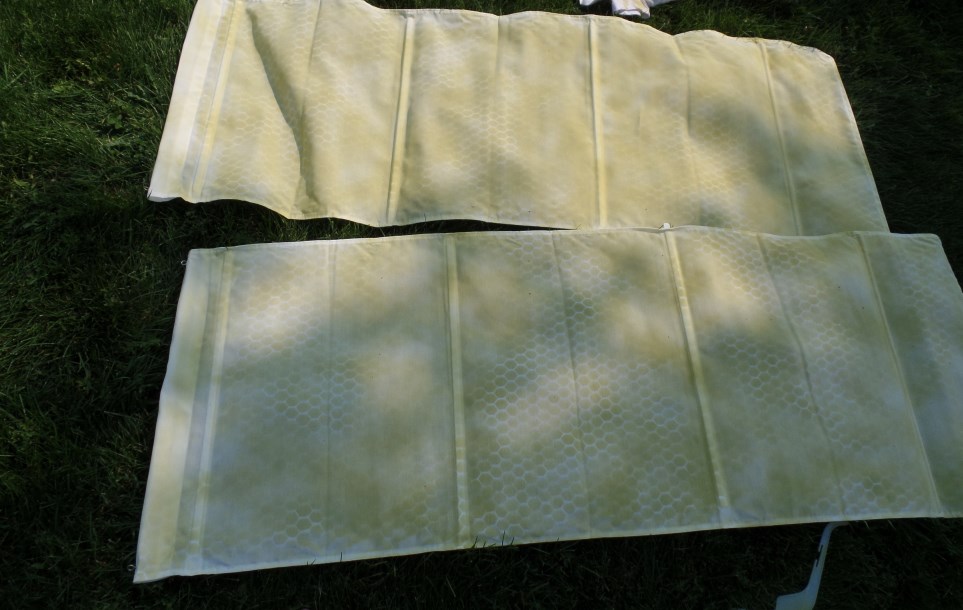
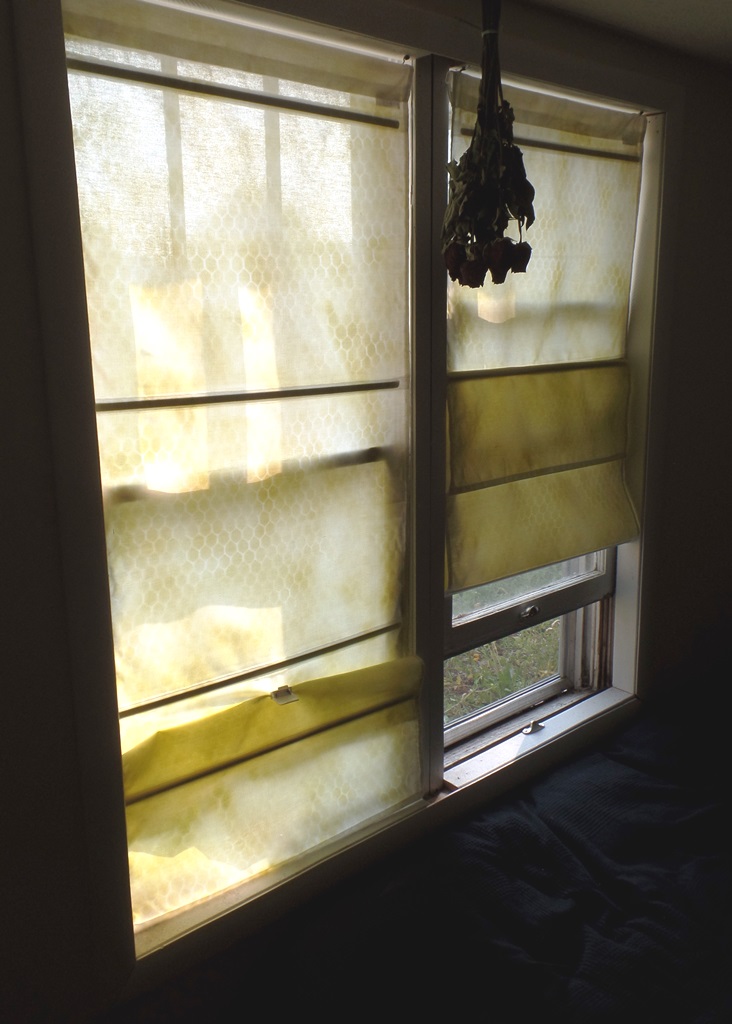
My grandmother gave me a juicer on a recent visit. It was sitting on the counter and needed to be cleaned up before I put it away. While we were cleaning it up, I decided to juice a few tomatoes to see how it worked.

And I ended up with six quarts of tomato juice, canned and ready for storage. The pulp was put in the freezer for soup and such. Sometimes it’s hard for me to get the motivation to can anything: I enjoyed just kind of slipping into it after my first idea to juice a few tomatoes grew big rather quick. It’s really good tomato juice too.

Loveseat Rocker

I’ve been working on decorating my bedroom. I wanted a chair or loveseat in there, but the room is small and then we put a king bed in there, so I just didn’t have enough room. And then I found this at our local thrift store:

This small loveseat rocker was perfect. Small, but still big enough for two people and it fit in the space I had for it. The first thing I did was throw away the awful cushions that had too many reminders of cats. And the ruffle had to go.

After that was all gone, it had very nice bones. I thought of painting it (everyone paints furniture nowdays), but there was really no reason for it.

The cushions were a bit tricky to replace. The size was weird and didn’t fit anything ready made I could find. I didn’t want to get caught up trying to make them myself. I guess I could have saved the old ones and reupholstered them, but I think if it smells like cats, even a little bit, it should go into the garage. So I just didn’t get cushions that fit as well as before. Instead I found a lounge cushion in the as-is department of Ikea that was about the right size to use on the bottom, and put normal cushions on the top. Here is my rocker now:

It was a fun little find. Total cost (if you care, I always like to know how much stuff costs) was $25 for the rocker and $30 for the cushions. Time wise, a couple shopping trips and a few minutes just cleaning.