
I hadn’t enjoyed a homegrown tomato for around 20 months. Two tomatoes from the ‘Fourth of July’ plants ripened, and I gobbled them up for lunch. I sliced them to put on a sandwich, but ended up eating them plain and savoring the flavor.
This news story was extremely interesting to me. I grew up in Lehi, and my parents still reside there. To summarize the situation: the city is running out of drinking water. To counteract the shortage they are telling residents to not use culinary water on their lawns.
Shouldn’t people already be doing this? Lehi has a pressurized secondary system in place, and I am at a lose as to why someone would use culinary water when secondary is available. One issue might be water pressure: my parent have always had less than desirable water pressure, both in and out. But I see many residents watering their lawn daily and it’s a no brainier why. I would guess the majority of people over irrigate, in order to maintain a nice, lush, artificial green lawn.
So here is some simple irrigation advice:
I currently reside in an apartment. The grass is lush, green, attractive. It even has mushrooms growing in it. It is pampered with plenty of irrigation water (from the culinary system) every other day. It has been irrigated the same way since the system was turned on. Although the lawn does look nice, is it worth it? For me the answer is no. I believe the lawn could be nice and green (minus the mushrooms) with far less irrigation water. The lawn has a shallow root system, and does not react well to stress. Because of this, I do not consider it healthy. It is certainly not sustainable: as seen in Lehi, culinary water is not inexhaustible. We should not run out of drinking water in order to keep our lawns green.
For more information see:
I saw something out in the garden that has me very excited:

It has been far too long since I have had a homegrown tomato. I thought this plant was ‘Cherokee Purple’, but I’m thinking it is actually ‘Fourth of July’. I wasn’t too diligent with my plant labels. Actually, all my vining crops I grew from seed are still unknown due to the fact that I didn’t label properly and then the toddler ripped out the labels I did have. I’ve had a few die, including a pack that was both attacked by the toddler and then was deprived of water for a week, and have little idea what they were to replace them. So I think I planted french melons, hubbard squash, striped armenians, and zucchini, but I know that at least one of those crops doesn’t actually exist.
All my tomatoes are doing amazing. Most are in bloom, and many already have fruit set.

The peas are a good five feet tall, and outgrowing the support. I planted snap peas, because I love them, and I’ve been eating them as my primary vegetable lately. Still more blooms and young peas, so more snacking to come.

The spinach has bolted. I haven’t touched it lately, and will probably pull it up soon. But I loved having enough for salads and sandwiches why it lasted. I have no idea why I have never planted spinach before. It did quite well, even if the harvest was pretty short. Once the peas are done as well, I’ll rip out the section and plant beans.
I probably keep our family a bit too busy, but I love to go do things. My day is better if I get out of the house. Lately, we have mostly visited parks. Plus we have lots of family around to invite along or visit, which I love.
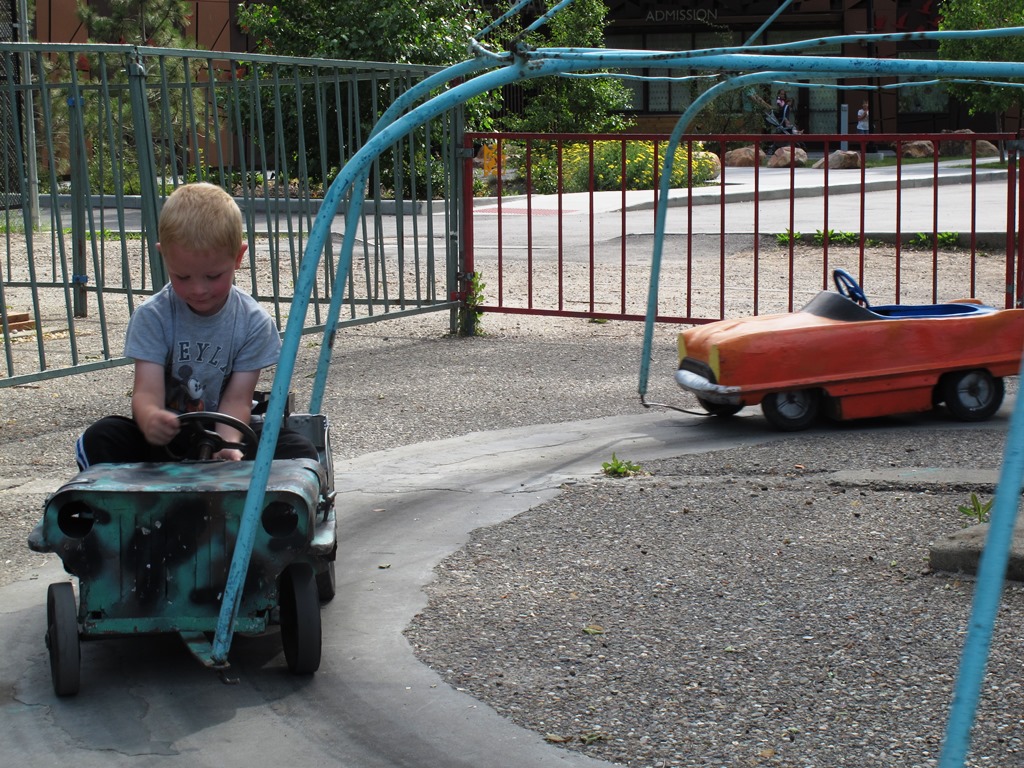
So he’s an inch away from being too tall to ride this. But he’s the perfect (or only?) age to enjoy it. He is a tall kid. Sometimes even I have to remember he is only three, even if he looks like he could pass for much older.
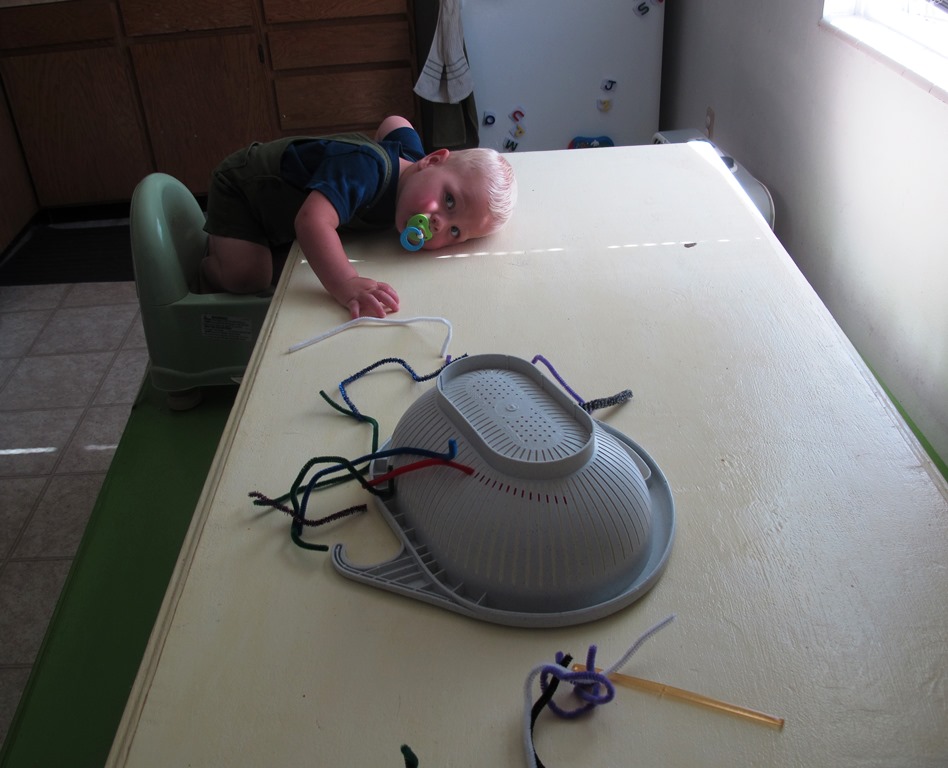
Here are some activities we’ve done. C did enjoy this one. He yanked out the pipe cleaners. PB turned it into a castle, junkyard, and a snake infested home. I love his creativity.
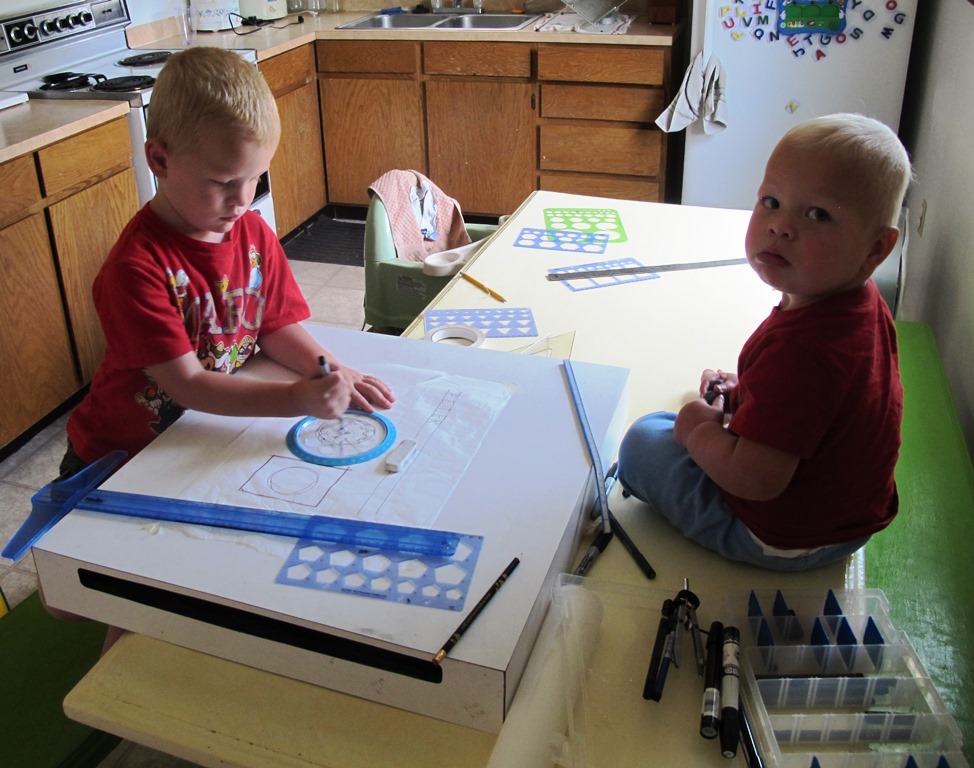
I pulled out my old drafting supplies. I prefer the computer. But these guys had fun with it.

This might be an interesting picture. But this is one of C’s favorite things. He will sit there forever, listening and watching to the wash go around and around.

Other mildly interesting events:
C won our family home evening game, fair and square. We played chutes and ladders, and even C could spin. PB cheated, I took second, and Joe gave up after another trip down the big slide.
PB recently wrote this small, yet awesome song: “You don’t have to get into trouble, trouble, trouble,” or the short version “your don’t get into trouble, trouble.” It’s pretty awesome, and as far as I can tell, completely original. He loves music, mostly listening, but then he will start singing along to some pretty complex songs.
An accident got me curious in organic weed killers. We made a giant volcano out on the lawn:

It effectively killed the lawn. I have read that household vinegar is not very effective as a weed killer. But this proved otherwise. So I filled up sprayer and sprayed a portion of the large weed field out back.

The advantage of this stuff is it is dilute vinegar so I didn’t mind when my little kids went out and helped looking like this:

After ten days, here are my experiences with household vinegar as a weed killer:

It did have some effect. You can see my spray path in the picture above. For some weeds vinegar would work. It didn’t kill the bindweed, but if I had a weed field full of small little annual weeds it might have done all right. If I really wanted an effective weed killer, I would go buy more concentrated stuff, and maybe mixed with clove oil. (Or maybe a product like Natural Weed Control
Overall, I think I’ll stick with hand weeding and glyphosate if I need to kill off weeds. But maybe vinegar can have an occasional turn as well. In smaller concentrations, it is often recommended to mix with dish soap and lemon juice, or various oils. Here’s another article that’s interesting, if you’d like more information on vinegar as a weed killer.
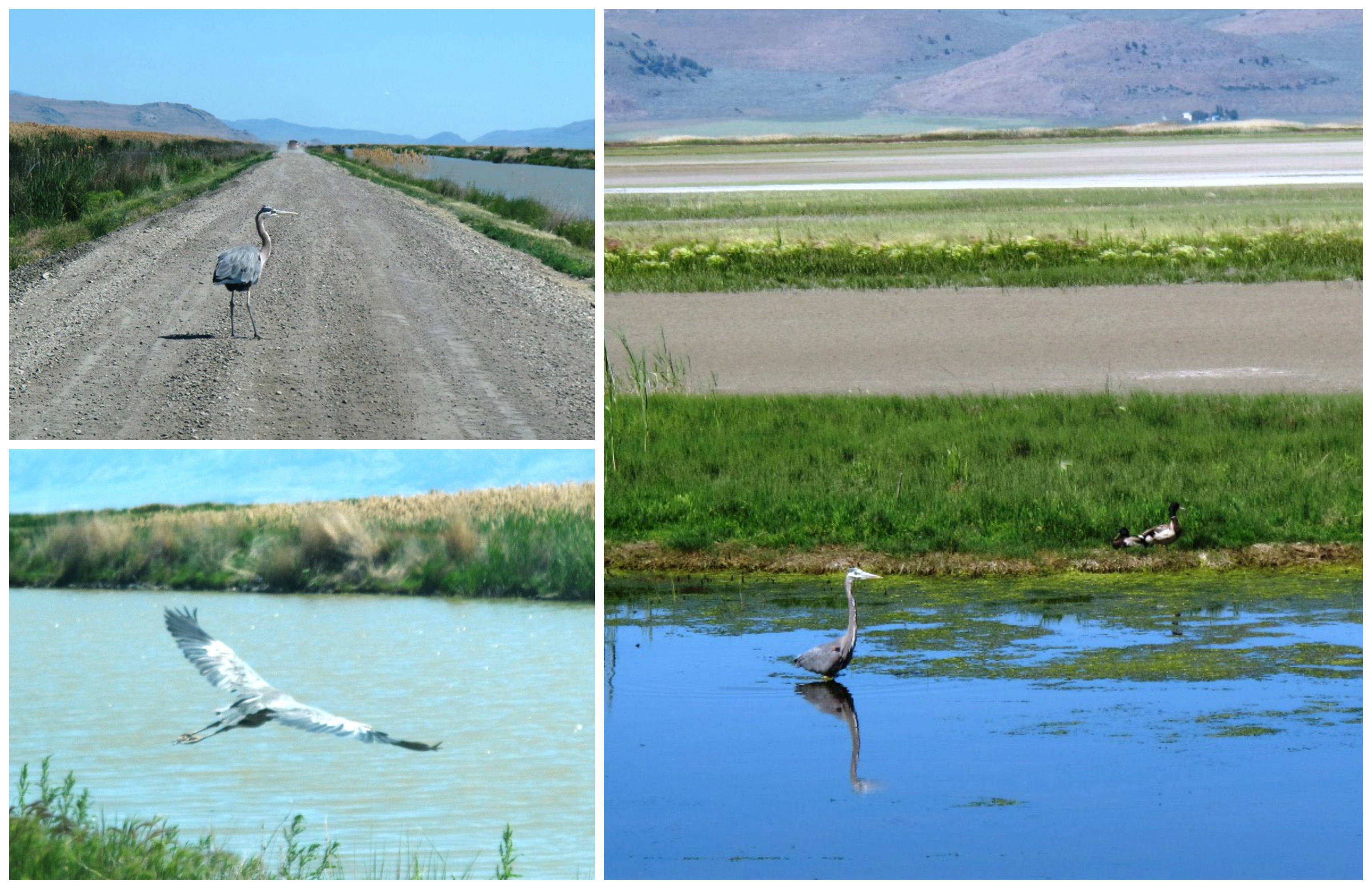
We went out to the bird refuge and drove the loop and dropped in at the visitors center. I enjoyed it and the kids didn’t seem to mind much. When PB got home he said to Dad unprovoked, “We saw a great blue heron on the road.” I was impressed he remembered the name. Curtis practiced saying “Duck” very close to his word-of-the-week “Stuck.”

Otherwise, we are just having good summer fun. I hung up my hammock, we’ve got out the slip’n ‘slide and pool, and I hacked together a small sandbox that Peter loves. The boys keep me busy and on my toes. Sometimes (especially if they or I are tired), things can get a bit exasperating. C is learning how to climb and get into everything, and they both know how to complain. But we have such good fun together too. They make mundane tasks like getting an oil change done new and exciting.

I recently visited a friends house and she had a question on tree staking. I’ve gone back and edited this post, first published four years ago.
Recently, as part of my work at a public garden, I planted several bareroot trees. The trees are doing quite well, but several were leaning, and not quite supporting themselves. This called for tree staking.
Tree staking is often incorrectly done. First of all, you only need to stake a tree if it needs it. Some of my trees would have toppled over or grown at forty five degree angles if I had done nothing to fix it. There were several other trees that I left. The trees were growing relatively straight and supporting themselves. No staking required, even though they were just barely planted.
There are also quite a few common mistakes made. First, the tree should be able to move around a bit. If it can move with the wind, it will grow a stronger, healthier trunk. Second, the material around the trunk should not rub and constrict the bark. With this in mine, I developed a cheap, easy method to stake a tree.
Materials:
I took the bike tube, and cut off about a six inch section, and then split it so it was no longer a tube. I then cut holes on either end, put it around the tree, and threaded the twine through. I placed the post opposite the lean or instability of the trees. Tie the twine on the post, and that’s all. I only did one post per tree, and it worked great. Two posts might be needed in windy areas.
Here’s a picture of how it looked when it was done:

You could use a fancier post or twine to make it look nicer. One last very important reminder: remove it in a year. I have tree die because people leave the staking on. This poor tree isn’t going to last long:

We went up to Nevada to visit my sister. And my sister takes better pictures, so just go over to her post. I drove about 17 hours alone with the boys. It wasn’t too bad. Not that I would recommend it. The kids didn’t sleep as much as hoped, but we only had one bad tantrum where I had to pull off to the side of the freeway. The trip was a lot of fun.

I’ve been thinking of preschool for PB and have been a little hesitant. I realized why lately. He’s finally old enough to play with and I don’t want to send him away. I still haven’t decided what I want to do, but I have realized I love being his mom. I love doing activities with him, teaching him and playing. He’s old enough play is more involved and actually engaging to me, not just him.


This is a lucky picture. I love bees.

Good idea of the day was to take pictures of the flowers I didn’t know with the sign in the frame.

I love the idea of this–it’s a pear tree trained over an arch.

This is mostly all natives, centered around a grove of natuuraling occuring oaks. Beautiful, and I can’t imagine it requires a lot of maintenance.

I loved this viburnum and lilac combo.

Here’s an oatmeal sensory bin even the very oral Mr. C can enjoy-

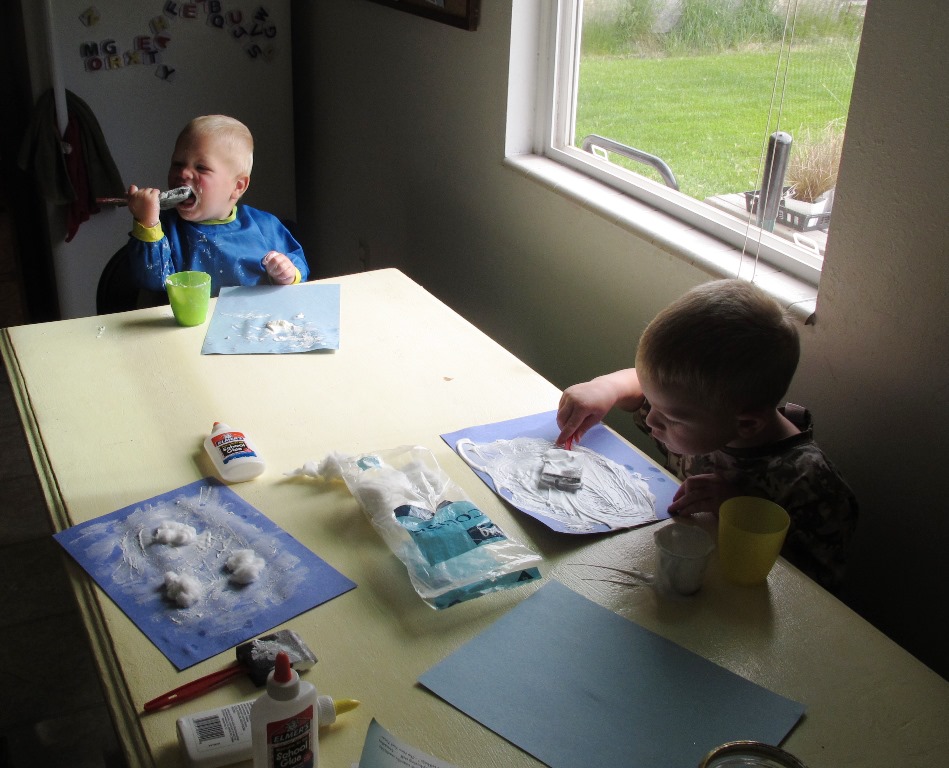
And here we are, all painting clouds. Don’t worry, Mr. C’s paint is sour cream.
PB is getting better at drawing. These are people. A bit scary, but fun to see him go beyond scribbles.

And this wonderful slip’in’slide came with the apartment. Too bad a tan for PB and Joe wasn’t included.

Potty training with PB is finally gaining some momentum. Except then he got diarrhea. Fun.

